
For trial attorneys, the stakes are real. Unclear or unsupported evidence can sink an otherwise strong case. A well-built, physics-based 3D exhibit can be the difference between a jury that "kind of gets it" and one that sees the collision unfold with total clarity.
This guide walks through how 3D reconstruction actually works, what makes it hold up in court, what it costs, and how to pick a firm that won't crumble under cross-examination.
Key Takeaways
- 3D reconstruction converts physical evidence into a verifiable, physics-based exhibit courts can admit
- Documented methodology, not flashy visuals, determines whether an exhibit survives Daubert/Frye challenges
- Costs and timelines hinge on case complexity and data-collection method, not a flat rate
- Early expert involvement preserves time-sensitive evidence like skid marks and debris fields
- Firm track record and testimony experience matter as much as the technology itself
What Is 3D Accident Reconstruction?
3D accident reconstruction is the process of translating physical evidence, scene data, and vehicle mechanics into a dimensionally accurate digital recreation of a crash. It's built from measurements, not memory or artistic guesswork.
Two formats serve different courtroom needs:
- Static 3D exhibits: fixed models showing vehicle positions, sightlines, or damage at a single moment
- Dynamic animations: physics-based sequences showing motion over time, from pre-impact speed through post-collision trajectories
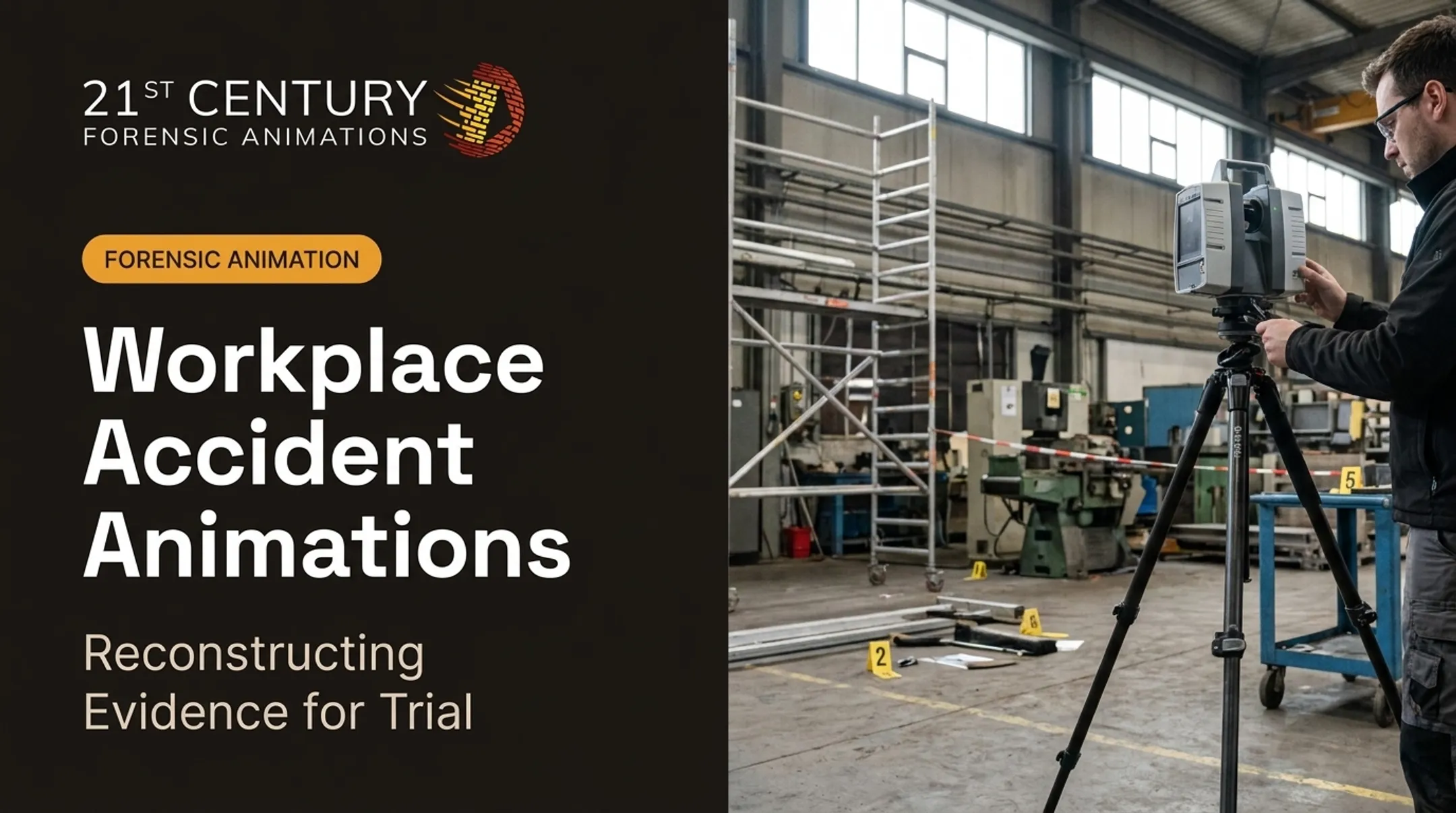
This methodology isn't limited to car crashes. The same approach applies to aviation incidents, product liability failures, fires and explosions, officer-involved shootings, and ballistics cases. Anywhere physical evidence needs to be translated into a spatial story, 3D reconstruction fits.

Why does this work better than verbal testimony or a 2D diagram? Jurors process visual information differently than spoken description.
A 2019 peer-reviewed mock-juror study found technical-language comprehension rates of 79% with photographs, 88% with 3D digitizations, and 94% with 3D-printed models. The difference wasn't statistically significant across the full sample, but the trend favors dimensional visuals over flat images.
The critical caveat: courts don't admit these exhibits because they look convincing. They admit them because the underlying data is documented, verifiable, and grounded in physics, not because an animator made a compelling story.
The Technology and Process Behind 3D Reconstruction
Data Collection and Evidence Preservation
Everything starts with capturing the scene before evidence disappears. Skid marks fade. Debris gets cleared. Vehicles get towed and repaired. Speed matters here as much as precision.
Common data-collection tools include:
- Drone/photogrammetry surveys for aerial context and large-scene coverage
- 3D laser scanning and LiDAR for dense, measurable geometry
- Event data recorders (EDRs) for pre-crash speed, braking, and driver inputs
- Scene photos and video for cross-referencing measurements
- Exemplar vehicle inspections when the actual vehicle is unavailable
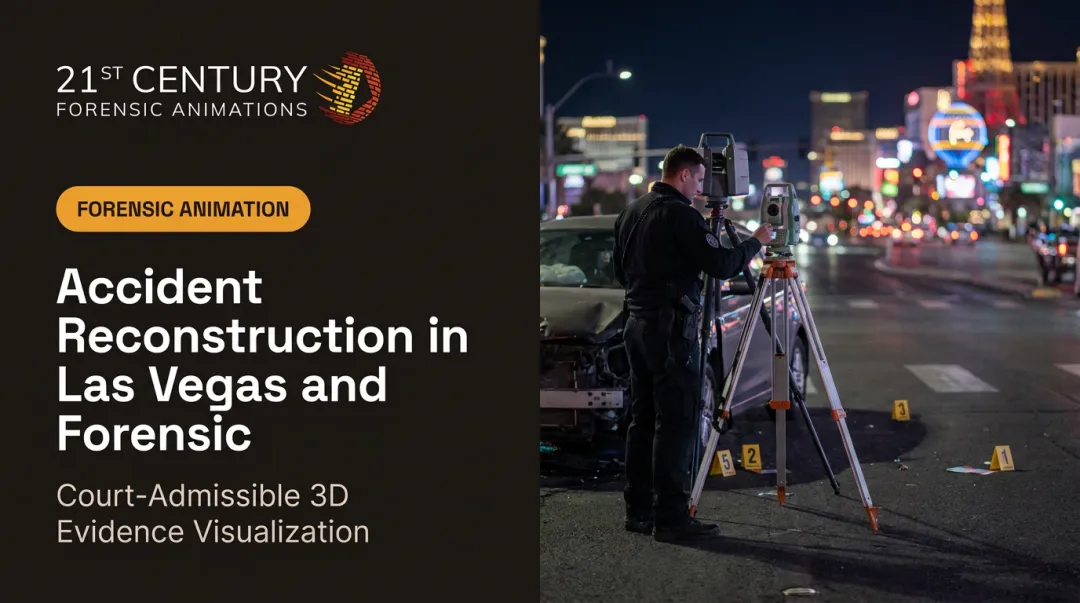
21st Century Forensic Animations uses terrestrial laser scanning to capture millions of spatial data points per scene, building dimensionally accurate point clouds. On larger or more complex scenes, mission-planned drone flights capture hundreds to thousands of overlapping images for conversion into aerial 3D models.

Analysis and Digital Twin Creation
Once the raw data is collected, analysts synthesize it into a digital twin of the crash scene. This stage relies on CAD modeling and physics-based calculations to determine:
- Vehicle speed and trajectory before and after impact
- Sightlines and time-distance relationships between parties
- Pre- and post-impact dynamics, including rotation and rest position
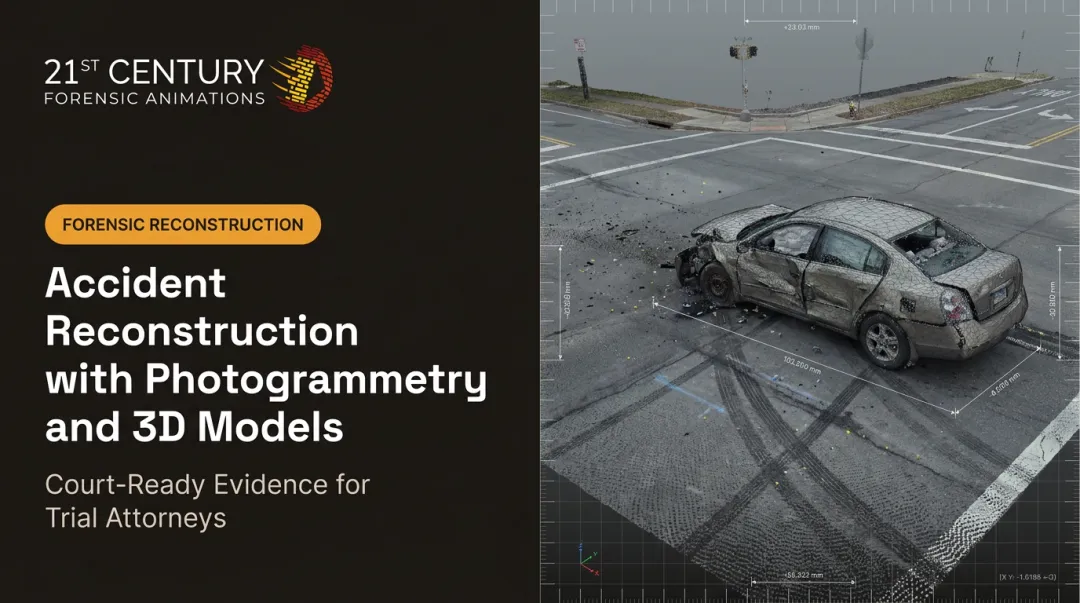
This is where the analytical heavy lifting happens. Photogrammetry, GIS software, and physics-based animation tools convert scattered evidence into a coherent, testable sequence of events.

Building the Court-Ready Animation
With that sequence established, the final animation is only as good as the documentation behind it. 21st Century Forensic Animations builds each reconstruction with complete methodology documentation designed to meet evidentiary rules across civil, criminal, state, federal, and international courts.
That documentation matters more than the render quality. It's what lets opposing counsel and the court trace every measurement back to its source.
Why 3D Reconstructions Win in Court
Admissibility isn't automatic. In Commonwealth v. Serge, the court allowed a computer-generated animation as demonstrative evidence, but warned it isn't inherently neutral or objective. Admission still required expert testimony, physical-evidence support, and a fair-and-accurate foundation.
Contrast that with State v. Dodds, where an animation was excluded. The underlying facts and figures weren't substantiated, and the expert hadn't even inspected the vehicle.
The lesson: methodology beats polish. A reconstruction survives Daubert or Frye scrutiny when every input is traceable and every assumption is disclosed.
These factors strengthen an exhibit's odds in court:
- Complete documentation so opposing experts can independently check the math
- Testimony capability: the expert who built the reconstruction can walk the jury through it and handle cross-examination
- A track record across multiple courts and case types, not one jurisdiction
21st Century Forensic Animations has been building court-admissible reconstructions since 1989. That is 37 years as the oldest independent forensic animation firm in the industry.
Its portfolio includes a five-vehicle road-rage collision reconstruction, an electrocution case showing power-line placement from laser-scan data, and a capital-murder case with bullet-trajectory and wound-position analysis. Each shows a different strength of the medium: simplifying multi-vehicle chaos, visualizing invisible hazards, and turning split-second forensic events into something a jury can follow.
Cost and Timeline: What Attorneys Should Expect
How much does it cost?
There's no flat rate here, and any firm quoting one without reviewing your case should raise a flag. Pricing depends on:
- Scene complexity and number of vehicles or objects involved
- Data-collection method (photo-only analysis vs. laser scanning or drone capture)
- Length and detail level of the final animation
- Whether expert testimony and deposition support are included A free consultation is the fastest way to get a case-specific number. First-time clients working with 21st Century Forensic Animations can request a complimentary case review by calling (800) 460-2887, available 24/7.
How long does it take?
Timelines swing from days to several weeks, depending on scene complexity and how much lead time you have before trial. Historically, forensic animation timelines have dropped sharply as technology improved. Early projects sometimes took two years and cost roughly $250,000, according to Forensic Magazine's history of the field. Modern teams often complete comparable work in eight to ten weeks. If your trial date is looming, don't wait. Firms available 24/7 and committed to meeting deadlines can accommodate rapid-response needs, but early engagement always gives more room for revisions and rebuttal prep.
How Accurate Is 3D Accident Reconstruction?
Modern capture tools are precise. Laser scanners like the Leica RTC360 report 3D point accuracy in the range of 1.9mm at 10 meters, scaling to about 5.3mm at 40 meters.
Photogrammetry and drone-based methods can also achieve strong results. A 2024 peer-reviewed traffic reconstruction study found UAV-based methods carried larger error margins (roughly 1.3–2cm) compared to terrestrial laser scanning (4–6mm).
Here's the part attorneys often miss: instrument specifications aren't the same as scene accuracy. A scanner's brochure number reflects lab conditions on a single target. Real-world accuracy depends on:
- Registration quality when stitching multiple scans together
- Occlusion, lighting, and reflective surfaces at the actual scene
- The analyst's calibration and control-point placement
- How rigorously the methodology is documented

That last point is what allows opposing counsel to independently verify your numbers instead of just taking your word for it. Accuracy without documentation is just a claim.
Choosing the Right Forensic Animation Partner
Not every firm that can render a 3D animation can defend one in court. Before hiring, look for:
- Courtroom track record across civil, criminal, state, and federal matters, not only technical portfolio pieces
- Testimony experience: experts who can explain methodology clearly when opposing counsel challenges it
- Transparent process: a clear walkthrough of data sources, software, and assumptions before you commit
- Free consultation for first-time clients so you can assess fit before signing
21st Century Forensic Animations offers a complimentary case review for first-time clients. It covers the evidence on hand and which capture method fits the case: laser scanning, drone imagery, or photogrammetry.
With 37 years across civil, criminal, and international rules of evidence, the firm builds exhibits meant to survive scrutiny in court, not only to look polished in a demo reel.
Frequently Asked Questions
How much does 3D accident reconstruction cost?
Costs vary based on data-collection method, scene complexity, and animation length. There's no standard rate. A free consultation is the best way to get a case-specific estimate.
How long does 3D accident reconstruction take?
Timelines typically run from a few days to several weeks, depending on scene complexity and how much lead time exists before trial. Expedited work is available for urgent deadlines.
How accurate is 3D accident reconstruction?
Modern laser scanning and photogrammetry can achieve sub-centimeter to millimeter precision. Actual accuracy depends on data quality, calibration, and methodology, not just the equipment used.
What types of cases use 3D accident reconstruction?
Beyond motor vehicle accidents, it's used in aviation incidents, product liability, fires and explosions, officer-involved shootings, and ballistics cases.
Can 3D reconstructions be challenged in court?
Yes, they can face Daubert or Frye challenges over reliability and methodology. Complete documentation and expert testimony typically help exhibits withstand that scrutiny.
Do I need to hire the reconstruction expert early in my case?
Yes. Early involvement helps preserve time-sensitive evidence like skid marks, debris fields, and vehicle damage before it degrades or disappears.