
Skid marks are some of the most persuasive physical evidence in a motor vehicle case, but they're also among the most misunderstood. Untrained observers misread mark types, miss the window for documentation, or apply the wrong formula and get speed estimates that are off by double-digit miles per hour. This guide breaks down how skid marks form, what they can and can't tell you, how reconstructionists calculate speed, and why forensic animation has become essential for explaining this evidence to a jury.
Key Takeaways
- Skid marks are friction marks from a sliding tire, not rubber deposits—and can fade within minutes
- Mark type (straight skid, yaw, scuff, gap) changes the math; misclassification skews speed estimates
- ABS-equipped vehicles often leave faint or no visible skid marks despite hard braking
- Courts require animations to be authenticated, fair, accurate, and grounded in real data
- Forensic animation turns drag-factor calculations into visuals a jury can follow
What Are Skid Marks and Why Do They Matter in Accident Investigations
A skid mark forms when a tire locks and slides across the road surface without rotating. Arizona's peace officer training standards define it the same way: a friction mark from a non-rotating, sliding tire.
That mark is one of the clearest indicators of a vehicle's position, direction of travel, and speed loss before impact—which is why it carries weight in liability disputes. According to NHTSA's Special Crash Investigations program, skid and yaw marks are documented with other scene evidence to establish crash dynamics and point of impact. Skid marks can:
- Establish direction of travel before the collision
- Indicate where braking began and how hard
- Corroborate or contradict a driver's statement about what happened
- Help narrow down the approximate impact location
One common mistake: treating the debris field as the point of impact. Debris scatters with speed, mass, and collision angle. It corroborates other evidence; it is not a standalone marker. A reconstructionist matches debris location to tire marks, gouges, vehicle damage, and rest positions—not one data point alone.
Types of Tire Marks Investigators Look For
Not every dark line on the pavement is a locked-wheel skid. Investigators separate several mark types:
- Straight skid marks: consistent width and relatively straight striations; braking without steering input
- Yaw (critical-speed) marks: curved paths where inertia exceeded available traction, often before a spin or rollover
- Acceleration scuffs: less common at crash scenes; can look like skids but start dark and lighten as wheelspin gains grip
- Skip/gap skids: intermittent marks from rough pavement, suspension bounce, or brake release-and-reapply
- Scrub marks: rotating (not locked) tire sliding diagonally; shorter-lived, more variable width
- Flat-tire scuffs: patterns from a tire already deflated before or during the event

Skid marks also darken as friction builds. That progression helps separate them from acceleration scuffs, which usually start dark and lighten.
ABS and missing marks: Locked-wheel skids leave solid, continuous dark lines. Anti-lock brakes prevent full lockup, so ABS-equipped vehicles often leave faint, intermittent marks—or none—even under hard braking.
That gap has changed liability outcomes when an insurer treated "no skid marks" as proof of "no braking."
How Long Do Skid Marks Last and How Fast Was the Vehicle Going
Skid marks are not permanent evidence. Arizona POST's traffic collision training notes that a mark's lifespan can range from a few minutes to several weeks, depending on:
- Weather
- Traffic volume
- Road maintenance
- Pavement type
There's no single fixed timeline—and that uncertainty is the risk.
A single rainstorm, a night of heavy traffic, or a routine resurfacing crew can erase evidence that would have decided a case. This is why rapid scene documentation isn't optional. Once a mark fades, no amount of expert analysis can bring it back.
Can You Calculate Speed From a Skid Mark?
Yes, using a drag-factor formula. For a straight skid, the standard equation is:
S = √(30 × d × f)
Where S is speed in mph, d is skid distance in feet, and f is the drag factor (a measure of road friction). Yaw marks use a different formula entirely, based on the radius of the curved path rather than straight-line distance.
A straight skid and a yaw mark use different physics. A crash reporting manual shows a 100-foot straight skid at a 0.65 drag factor producing roughly 44 mph, while a yaw mark with a 68.5-foot radius at the same drag factor produces about 26 mph.
Same drag factor, different results—because the mechanics aren't the same. Misclassify the mark and your speed estimate could be off by 15–20 mph or more.

Reconstructionists also have to document:
- Road grade and surface type
- Weather conditions at the time
- Tire condition and wear
- Wheelbase (since it factors into measuring the "usable" skid distance)
Skip any of these, and the calculation becomes vulnerable to challenge.
How Skid Mark Evidence Gets Contested in Court
Skid mark evidence rarely goes unchallenged. Opposing experts routinely dispute:
- Mark classification – was it really a straight skid, or a yaw mark misread under pressure?
- Measurement accuracy – was the full mark measured, including gaps or skip segments?
- Friction assumptions – was the drag factor tested on-site or estimated from a table?
Courts have repeatedly wrestled with how much weight to give these opinions.
In Swiney v. Overby, the Virginia Supreme Court reversed a judgment because the reconstruction opinion ignored a key variable: the vehicle's actual brake condition. Without it, the court found the opinion too hypothetical.
In State v. LaBrutto, New Jersey's high court allowed a non-expert officer's point-of-impact opinion based on training and experience. It still noted that more technically complex cases call for a qualified reconstruction expert.
For attorneys, the practical point is this: police reports and insurance adjusters may draw conclusions from the same skid marks, but those conclusions are not automatically defensible under cross-examination. An independent reconstructionist retained by counsel documents methodology in a way a routine police report typically does not.
There is also a communication gap. Jurors without a physics background struggle to picture a drag-factor equation or a radius calculation from a verbal description alone. Visual reconstruction closes that gap for the jury.
From Physical Evidence to Courtroom Visual: The Role of Forensic Animation
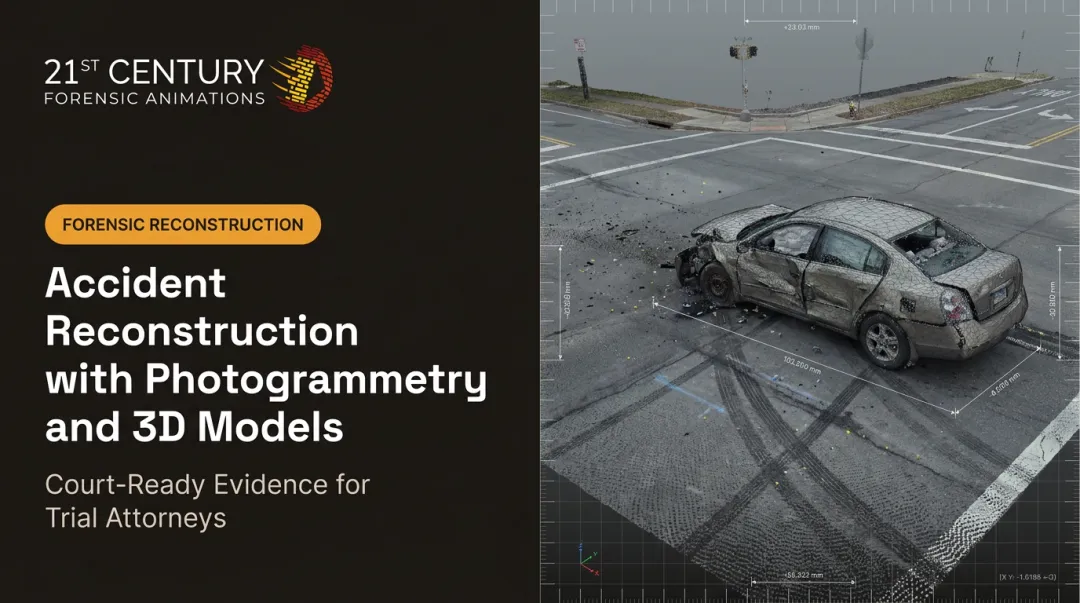
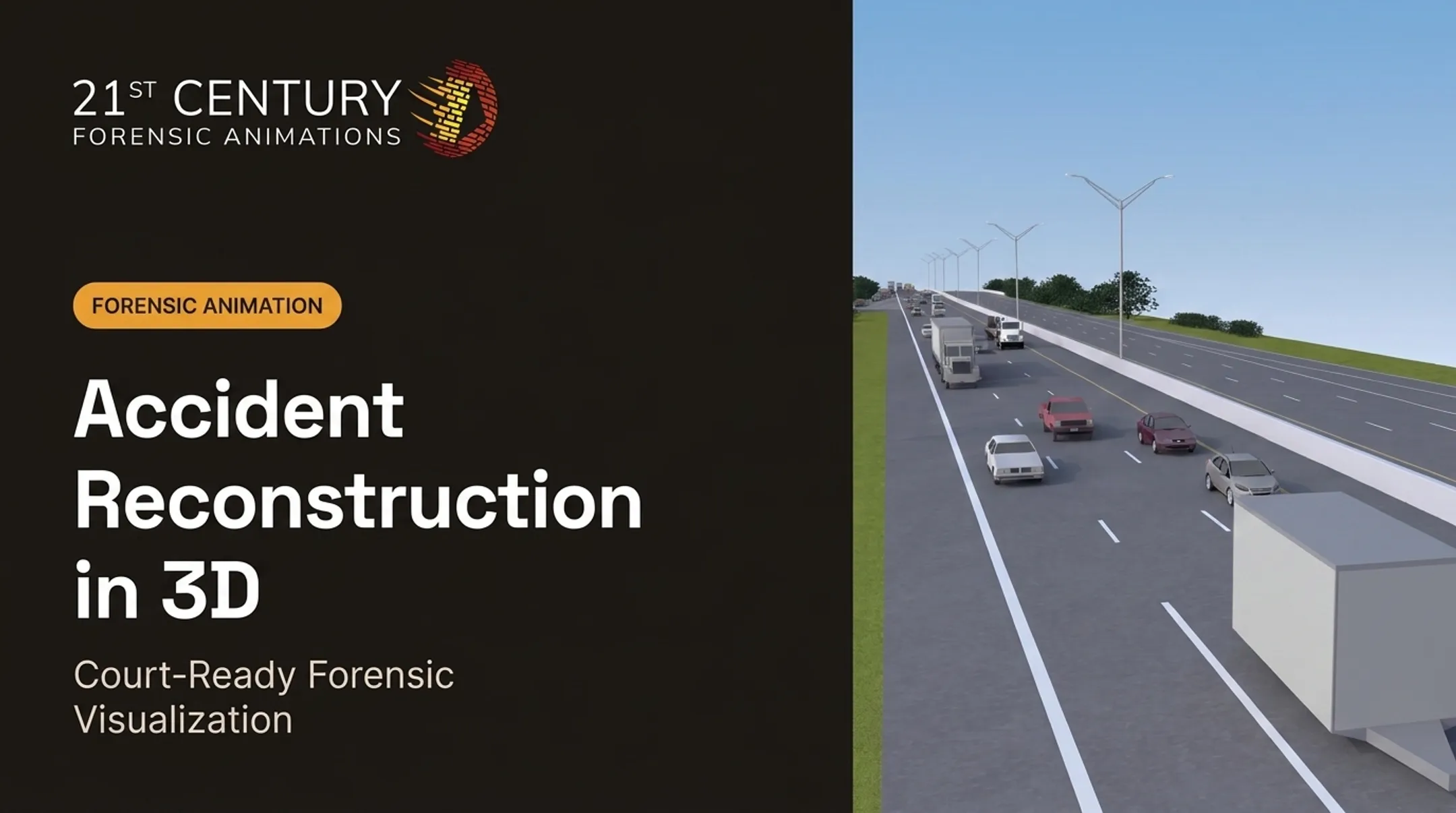
21st Century Forensic Animations converts skid mark measurements, drag-factor calculations, and scene photogrammetry into a dimensionally accurate 3D animation. The exhibit shows the vehicle's speed, path, and braking sequence from the recorded evidence.
How the process works:
- Close-range photogrammetry extracts three-dimensional measurements from scene photographs, video, surveillance footage, or dashcam recordings.
- Skid mark length, position, and shape translate into precise digital coordinates.
- Drag-factor calculations and physics-based modeling determine speed and vehicle path.
- The animation is built to match real, documented measurements.

Every animation includes complete methodology documentation: the underlying evidence, tools, and calculations. That record matters under admissibility scrutiny.
Courts have held that computer-generated animation can be admitted as demonstrative evidence when it is authenticated, relevant, and a fair, accurate representation—standards articulated in cases like Clark v. Cantrell. Federal courts have similarly allowed reconstruction animations when they are grounded in the evidence and presented as an expert's illustrated opinion, not a literal recreation.
A study in Law and Human Behavior found animated displays had a greater impact on mock jurors than oral testimony alone. Neutral animations also moved judgments toward the underlying physical evidence. The aim is clarity tied to the facts the jury must weigh.
As the oldest independent forensic animation firm in the industry, founded in 1989, we have translated skid mark and tire-mark analysis into court-ready exhibits across thousands of motor vehicle cases. That work spans civil and criminal matters domestically and internationally.
If you are weighing whether animated reconstruction would strengthen a disputed liability case, we offer a free consultation for first-time attorney clients. Call (800) 460-2887, available 24/7.
Best Practices for Preserving Skid Mark Evidence After a Crash
Given how quickly this evidence disappears, timing is everything.
- Photograph the scene immediately. Capture multiple angles with a scale reference in frame before vehicles are moved or traffic resumes
- Bring in a reconstruction expert early. Marks that fade within hours can't be recovered later, no matter how skilled the analysis
- Request the full police report and early scene photographs. Documentation quality varies widely by department and by officer

Photogrammetry can still extract accurate measurements from existing photos or dashcam footage after the fact, but only if that visual documentation exists in the first place. Missed scene photos usually mean missed measurements—and a weaker reconstruction.
Frequently Asked Questions
Why are skid marks important in accident investigations?
They establish direction of travel, braking behavior, and approximate point of impact. They can also confirm or contradict a driver's account of the crash. Combined with other scene evidence, they help reconstructionists build a defensible sequence of events.
How long do skid marks stay on the road?
Fading can begin within minutes, and full disappearance can happen within hours to weeks depending on weather, traffic volume, and pavement type. There's no fixed timeline, so fast documentation matters.
Can you tell how fast a car was going by the skid marks?
Yes, using drag-factor formulas that combine mark length, road friction, and mark type. Straight skids and yaw marks use different equations, so correct classification is essential for an accurate estimate.
Do skid marks always form during hard braking?
No. ABS-equipped vehicles often leave faint, intermittent marks or none at all, even during hard braking, since the system prevents full wheel lockup.
Can weather destroy skid mark evidence before it's documented?
Yes. Rain, traffic, and road maintenance can erase marks within hours, leaving investigators without a key physical record of speed and path.
How do attorneys use skid mark analysis to prove fault in court?
Reconstruction reports and forensic animations turn skid-mark calculations into visuals judges and juries can follow. Those exhibits support liability arguments and help counter opposing experts' narratives.