
This is where accident reconstruction experts step in. They rebuild the crash using physics, not opinions.
Insurers pay closer attention when a claim is backed by measured data instead of a driver's recollection. A skid mark measurement or an Event Data Recorder readout carries more weight than "I think they ran the light."
This article covers how reconstruction experts work, what evidence they rely on, why insurers push back, and how to pick the right firm for your case.
Key Takeaways
- Reconstruction relies on physics and engineering, not driver statements, to establish fault objectively
- Insurers often run their own reconstruction to limit payouts, but independent experts counter that analysis
- 3D animations translate complex crash dynamics into clear visuals juries and adjusters can follow
- Court-tested experts with documented methodology strengthen both settlement talks and trial testimony
What Do Insurance Accident Reconstruction Experts Do?
Accident reconstruction is the scientific process of recreating a collision using physical, digital, and testimonial evidence. It answers how and why the crash happened from physical evidence, independent of conflicting statements.
The Society of Automotive Engineers describes this discipline as applying physics and empirical data to intersection collisions, pedestrian and motorcycle crashes, rollovers, and heavy-truck incidents, according to SAE's crash reconstruction course overview. That range matters because insurers handle all these claim types differently.
Where reconstruction findings get used:
- Claims negotiations, to counter an insurer's initial fault assessment
- Mediation, where visual clarity often speeds up settlement
- Courtroom testimony, where the expert explains findings directly to a judge or jury
Insurer-hired vs. independent experts:
- Insurer-hired reconstructionists work for the carrier's interests
- Independent experts retained by claimants or attorneys use the same physical evidence, without an incentive to minimize the payout
Findings typically arrive as written reports, scene diagrams, or 3D animations. 21st Century Forensic Animations, for instance, documents cases like a five-vehicle road-rage collision and an electrocution matter using laser-scan-derived power-line placement, both built into court-ready visual exhibits rather than text-only reports.

The Evidence and Methodology Behind Reconstruction
Reconstruction pulls from three evidence categories. Strong analysis rarely relies on just one.
Scene and Vehicle Evidence
NHTSA's investigation process identifies skid and yaw marks, point of impact, vehicle rest positions, and safety-system status as core scene evidence, per NHTSA's Special Crash Investigations program. Road design, weather, and lighting at impact complete the scene picture. Vehicle-side evidence adds another layer:
- Crush damage patterns and depth
- Airbag deployment timing
- Tire wear and brake condition
Digital Evidence and Its Limits
Event Data Recorder data, dashcam footage, traffic camera video, and cell phone records round out the picture. EDR data specifically requires fast, correct preservation. Federal rules cover EDR-equipped vehicles built after September 2012, but the data window is short—often 30 seconds or less. Retrieval needs vehicle access and specialized equipment. Wait too long, and that data can be overwritten or lost entirely.
Turning Raw Data Into Court-Ready Exhibits
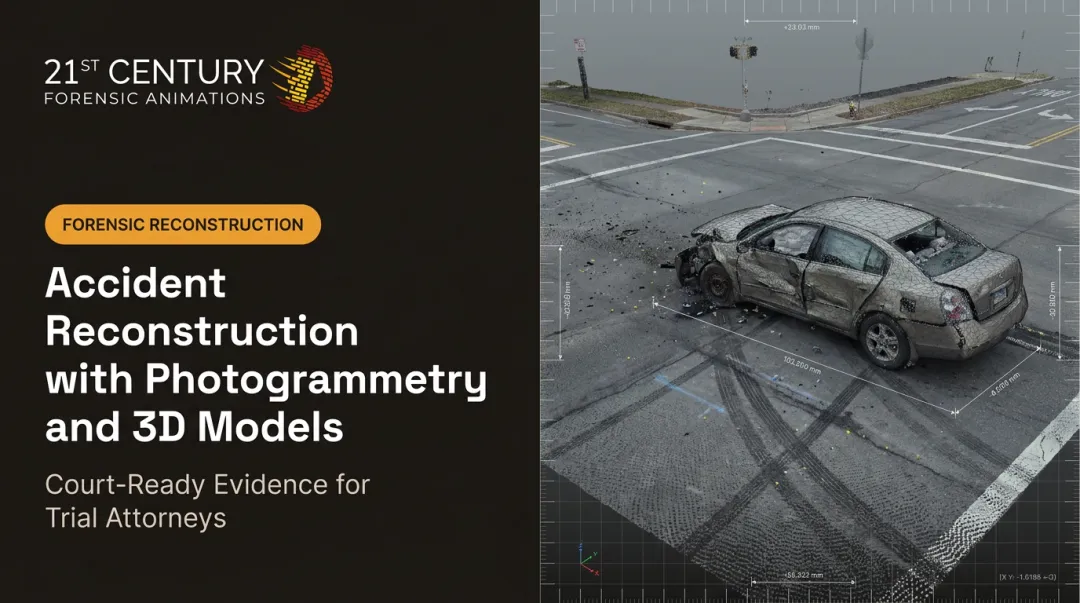
Analytical methods—speed and stopping-distance calculations, momentum and crush analysis, and time-distance studies—produce numbers. Numbers alone rarely persuade a jury. 21st Century Forensic Animations turns that data into dimensionally accurate 3D visualizations built from laser scans, drone imagery, and photogrammetry:
- Terrestrial laser scanning captures millions of spatial measurements as precise point clouds
- Photogrammetry extracts 3D measurements from photographs and video, including dashcam or surveillance footage The resulting exhibits are built to meet evidentiary standards across civil, criminal, state, federal, and international jurisdictions.

Why Insurance Companies Dispute Reconstruction Findings
Insurers frequently commission their own reconstruction. The motivation is straightforward: shifting even partial fault onto the claimant reduces what they owe.
Comparative negligence is the mechanism. Under Illinois's modified comparative negligence rule, a claimant found 20% at fault recovers only 80% of damages, according to Illinois Department of Insurance guidance. New Jersey's insurance department gives a similar example: 50% fault cuts a $1,000 claim down to $500. Rules vary by state, so the applicable fault threshold matters to the final number.

Common insurer tactics include:
- Emphasizing the claimant's speed or distraction over other causal factors
- Disputing whether the crash actually caused the claimed injuries
- Bringing in biomechanical experts to challenge injury causation
An independent reconstruction can expose weak spots in the insurer's version. Skid marks get misread. Road defects get conveniently ignored. Reaction-time assumptions get stretched to fit a preferred narrative. When an independent expert re-examines the same physical evidence with sound methodology, these gaps tend to surface.
Choosing the Right Accident Reconstruction Expert
Not every reconstructionist is equally prepared for court. Look for these markers before hiring:
- A documented track record across relevant case types, not just a general engineering background
- Methodology transparency — the expert should explain exactly how they reached their conclusions, not just present a finished animation
- Courtroom testimony experience, ideally with cases that survived evidentiary challenges
- Working knowledge of admissibility rules across civil, criminal, state, federal, and international jurisdictions. A method sound in one court does not automatically pass in another
These markers separate courtroom-ready experts from generalists. 21st Century Forensic Animations, founded in 1989, is the oldest independent forensic animation firm in the industry.
Over 37 years, the firm has built exhibits for 13 or more case types, from motor vehicle accidents to capital-murder trials involving bullet-trajectory reconstruction. Every animation uses objective, verifiable data from laser scans or photogrammetry, with full methodology documentation attorneys can defend in court.

Cost and Timing Considerations
Reconstruction costs vary widely depending on case complexity, vehicle count, and whether simulation or 3D animation work is needed. There's no universal price sheet here. A single-vehicle case with clear EDR data costs far less to analyze than a multi-vehicle pileup requiring laser scanning and drone-based scene mapping.
What drives cost up:
- Number of vehicles and parties involved
- 3D animation requirements beyond a written report
- Scene complexity requiring laser scanning or drone imagery
- Expert testimony and deposition time
Timing matters just as much as budget. The longer you wait to engage an expert, the more evidence disappears:
- Skid marks fade
- Vehicles get repaired or scrapped
- Dashcam footage gets overwritten
- EDR data can be lost without prompt retrieval
21st Century Forensic Animations offers a free consultation for first-time clients so you can evaluate case needs before committing. They're available 24/7 by phone or online form—critical when evidence is degrading by the hour.
Frequently Asked Questions
How much does accident reconstruction cost?
Costs typically run from a few thousand to tens of thousands of dollars, depending on case complexity, vehicle count, and whether animation or simulation work is needed. Many firms, including 21st Century Forensic Animations, offer a free initial consultation to scope the work.
How does accident reconstruction work?
Investigators collect physical, digital, and testimonial evidence, then apply physics-based calculations to determine speed and impact dynamics. Findings are presented in written reports, diagrams, or 3D animations.
Can accident reconstruction overturn a police report?
Yes. Police reports are based on initial, often limited, scene observations. A thorough scientific reconstruction, backed by stronger measured evidence, can correct or directly contradict those early assumptions.
Do all accident cases need a reconstruction expert?
Not every case does. Reconstruction adds the most value when fault is disputed, injuries are severe, or key evidence is incomplete or contested.
Is accident reconstruction evidence admissible in court?
Generally, yes, when the methodology is properly documented and meets the jurisdiction's evidence rules. Federal courts apply Rule 702's reliability standard, while state courts may follow Daubert, Frye, or a modified approach.
Who typically pays for an accident reconstruction expert?
Attorneys often advance these costs upfront as a case expense, then recover them from the settlement or verdict. Payment terms should be spelled out clearly in the attorney-client agreement.