
Attorneys can have the strongest witness on the stand and still lose ground if a photo gets excluded, a diagram confuses the jury, or opposing counsel successfully challenges an exhibit's foundation. Exhibit admissibility, organization, and clarity are trial skills in their own right, separate from questioning a witness.
This guide covers what legal exhibits are, how courts categorize and admit them, how to build an exhibit list, and how demonstrative tools like 3D reconstructions can make complex evidence understandable to a jury.
Key Takeaways
- An exhibit is any physical or documentary item formally offered as evidence, distinct from witness testimony
- Admissibility hinges on relevance, authentication, lack of unfair prejudice, and hearsay compliance
- Real, demonstrative, documentary, and digital exhibits each serve different courtroom functions
- Numbering and lettering conventions vary by jurisdiction — always check the local rule or judge's order
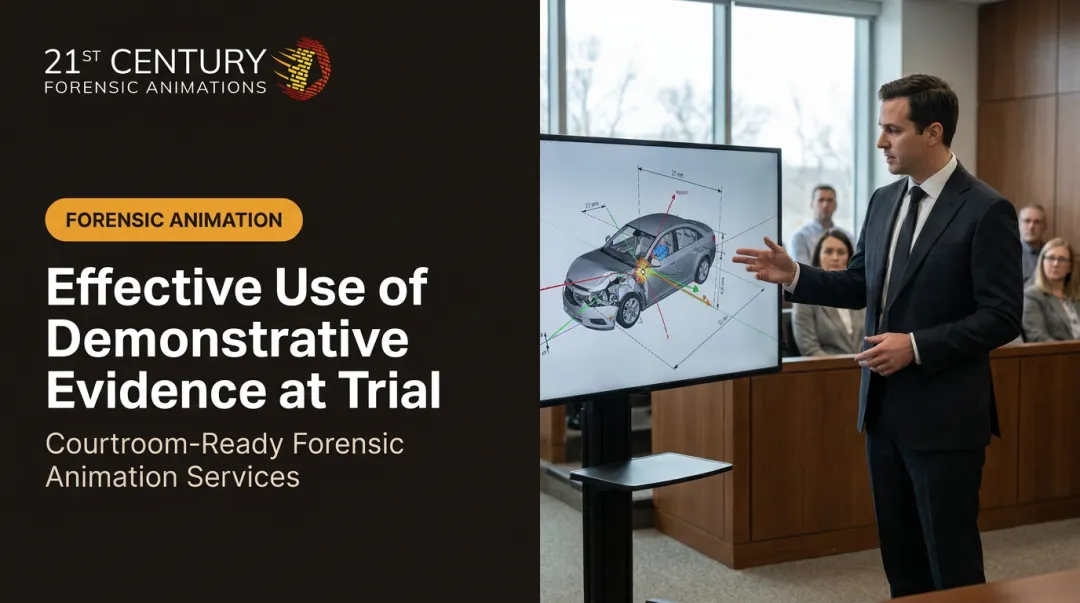
- Forensic animations and 3D reconstructions help juries grasp complex technical evidence
What Does "Exhibit" Mean Legally?
Cornell Law School's Wex legal dictionary defines an exhibit as a document, photograph, object, animation, or other device formally introduced as evidence in a legal proceeding. That's different from testimony, which is evidence delivered through a witness speaking under oath. An exhibit is something the court can hold, view, or play back.
The Progression: Marked, Offered, Admitted
Exhibits don't become evidence the moment they enter the courtroom. They move through stages:
- Marked for identification — given a number or letter so the record can reference it
- Offered — counsel formally asks the judge to admit it
- Admitted (or excluded) — the judge rules on whether the jury can consider it
The California Courts self-help guide walks through this exact sequence: show the item to opposing counsel, mark it, lay foundation, then ask the judge to admit it. Skipping steps, or assuming marking equals admission, is a common and costly mistake.

Numbers for Plaintiffs, Letters for Defense? Not Always
Many attorneys assume plaintiff exhibits get numbers and defense exhibits get letters. That's traditional in states like California, but it's not universal. Minnesota's court rules use a single numeric series for all parties. Always check the judge's pretrial order before assuming any convention applies.
Types of Legal Exhibits in Court
Two categories anchor most exhibit strategy:
- Real evidence — physical objects, weapons, original documents, photographs directly connected to the event
- Demonstrative evidence — items created to illustrate or clarify testimony, not evidence from the scene itself
Within those, exhibits break down further:
- Documentary exhibits — contracts, emails, medical records, business records
- Illustrative exhibits — charts, diagrams, timelines built solely to help jurors follow the facts
- Digital exhibits — recordings, data sets, animations, where authenticity often depends on the system that produced them
- Testimonial evidence — a witness's account; evidence, but not an exhibit in the traditional sense
Format-Based Types Attorneys Commonly Use
- Photographs and A/V recordings — capture scene conditions, injuries, or events as they occurred
- Transcripts and medical records — lock in statements, diagnoses, and treatment timelines
- Trial presentations and slide decks — organize documents, callouts, and sequence for the fact-finder
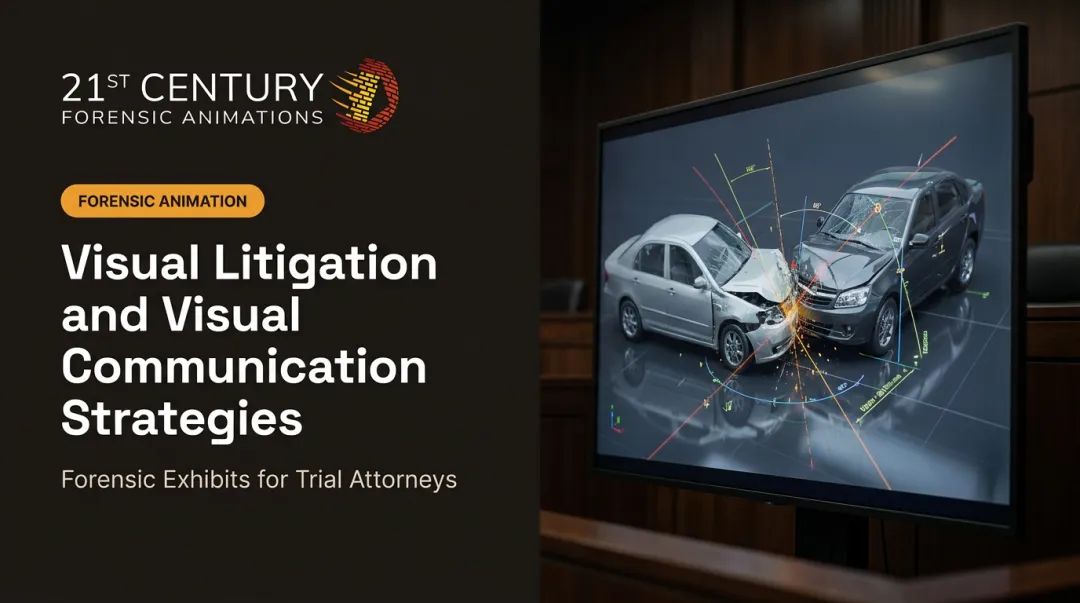
- 3D models, laser scans, and forensic animations — show spatial relationships, motion, and timing when still images fall short
Complex cases push attorneys toward specialized exhibits. Motor vehicle collisions, ballistics analysis, product liability failures, and officer-involved shootings often cannot be explained with a photograph alone. Those matters usually need reconstructions that show movement, timing, and spatial relationships in a form the court can evaluate.
Choose the exhibit type by answering three questions:
- How technical is the underlying data?
- Is the audience a judge or a jury?
- How strong is the evidence supporting any reconstruction?
Admissibility Requirements Attorneys Must Meet
Federal Rules of Evidence set the baseline gates every exhibit must clear:
| Requirement | Rule | Practical Test |
|---|---|---|
| Relevance | Rule 401 | Does it make a fact more or less probable? |
| Not unduly prejudicial | Rule 403 | Does probative value outweigh confusion or unfair bias? |
| Authentication | Rule 901 | Can you prove the item is what you claim? |
| No hearsay problem | Rule 802 | Is an out-of-court statement being offered for its truth? |
| Original content | Rule 1002 | Do you have the original document, or a valid substitute? |

Authentication carries a two-part burden:
- Proving the exhibit's origin (chain of custody)
- Demonstrating it hasn't been altered
This is where many exhibits get challenged. The underlying facts may be sound, but the foundation wasn't documented well enough.
State courts often add their own layers. Maryland's federal district court, for example, deems an exhibit admitted the moment its number is mentioned during testimony, unless a party requests otherwise. Always verify jurisdiction-specific rules rather than assuming the federal standard applies everywhere.
Exhibits built on dimensionally accurate, physics-grounded methodology face fewer admissibility fights. When a reconstruction is tied to verifiable laser scan data or photogrammetry rather than an artist's interpretation, opposing counsel has far less room to argue it's speculative or misleading.
Anticipating objections and prepping the authenticating witness in advance keeps trial momentum from stalling.
How to Make a List of Exhibits
Building an exhibit list starts during discovery, not the week before trial.
Best practices for the master list:
- Use a spreadsheet with Bates numbers tied to each document's source
- Assign a short, clear description to every entry
- Note the witness who will authenticate each exhibit
- Flag anticipated objections next to each item
- Separate "will offer" exhibits from "may offer if needed"
Federal Rule of Civil Procedure 26(a)(3) requires this disclosure at least 30 days before trial, with objections due within 14 days, though individual courts often set their own deadlines. One federal district, for instance, requires premarked exhibits and two copies of the list delivered a full business day before trial.
Exchange the list with opposing counsel well before the pretrial conference. This surfaces disputes early, when there's still time to prepare authentication testimony or find a workaround, rather than discovering an objection mid-trial.
Using Demonstrative and Forensic Exhibits to Strengthen Your Case
Jurors process visual information differently than spoken testimony. Peer-reviewed research on jury decision-making shows trials increasingly rely on animations, video, and digital presentations so jurors can interpret and retain complex evidence.
Forensic animation closes that comprehension gap. Raw physical evidence—accident data, ballistics reports, laser scans, photogrammetric measurements—becomes a dimensionally accurate, court-ready visualization a jury can follow.
21st Century Forensic Animations, founded in 1989 and based in Fort Worth, TX, has produced 3D reconstructions for civil, criminal, state, federal, and international courts for 37 years. Depending on the case, the firm draws on several data sources:
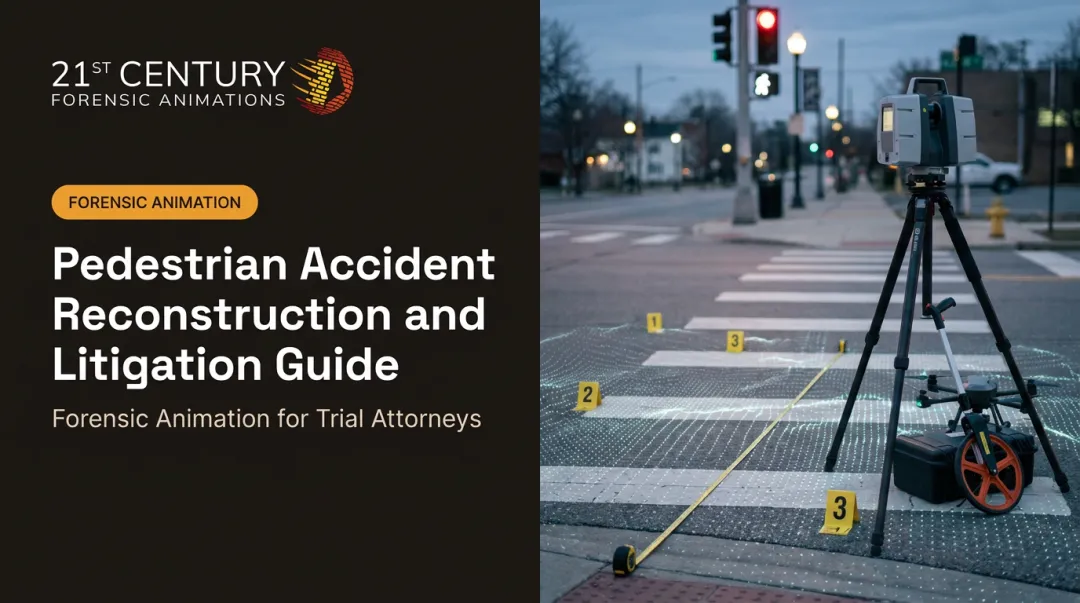
- Terrestrial laser scans that capture millions of spatial measurements for accurate scene replicas
- Drone imagery built into 3D models of large or hard-to-access scenes
- Photogrammetry that pulls measurements from photos, dashcam footage, or surveillance video
- Physical evidence and expert analysis that ground the animation in physics, not assumption

Portfolio work spans high-stakes fact patterns:
- Five-vehicle road-rage reconstruction
- Electrocution case tied to laser-scan-derived power-line placement
- Capital murder case with bullet trajectory and wound analysis
When an exhibit is challenged on authenticity or accuracy, complete methodology documentation gives the attorney a paper trail: how the reconstruction was built, what data supported it, and why it holds up. Judges and juries do not have to take the visual on faith.
The firm also provides expert witness testimony when that documentation must be explained on the record.
Best Practices for Presenting Exhibits at Trial
Good exhibits still fail if they're poorly organized or technically mishandled in the courtroom. A few habits reduce that risk:
- Organize exhibits with a table of contents in the trial binder or digital folder, and color-code by witness or topic
- Rehearse authentication with each witness so foundation questions land cleanly and objections don't catch anyone off guard
- Test all multimedia on the courtroom's projectors, screens, and audio before trial—not only on your laptop

The Federal Judicial Center's guide on courtroom technology warns that transitions, animation, color, and special effects can trigger objections if they weren't tested and disclosed in advance. A dry run days before trial catches problems when there's still time to fix them.
Frequently Asked Questions
What does "exhibit" mean legally?
An exhibit is a document, photograph, object, animation, or other item formally offered as evidence in a legal proceeding. It's distinct from testimony, which is evidence delivered orally by a witness.
What are the 7 types of evidence?
Legal literature commonly references real, demonstrative, documentary, testimonial, digital, scientific, and habit/character evidence. These categories overlap in practice and aren't a strict statutory list.
How do I make a list of exhibits?
Start during discovery: assign Bates numbers, write short descriptions, and note the authenticating witness for each item. Exchange the list with opposing counsel before the pretrial conference.
What's the difference between real and demonstrative evidence?
Real evidence is a tangible, original item connected to the case, like a weapon or contract. Demonstrative evidence is created afterward to illustrate or clarify testimony, such as a diagram or animation.
Should exhibits be numbered or lettered?
Many courts number plaintiff exhibits and letter defense exhibits, but this isn't universal — some jurisdictions use a single numeric series for everyone. Always confirm the local rule or judge's order.
How are forensic animations used as courtroom exhibits?
Forensic animations reconstruct events using physical evidence like laser scans and photogrammetry. Once an expert authenticates them as fair and accurate, courts typically treat them as demonstrative exhibits.