
Introduction
A collision on Las Vegas Boulevard rarely looks like a textbook crash. Tourists jaywalk between casino entrances, rideshare drivers double-park in traffic lanes, and out-of-state drivers misjudge intersections they've never seen before.
Police reports capture the aftermath, but they can't show a jury how fast a vehicle was traveling or why a pedestrian stepped into its path.
That gap creates a real problem. Judges, jurors, and insurance adjusters struggle to visualize speed, trajectory, and impact forces from written reports and scattered scene photos alone. Physics-based evidence needs a physics-based explanation.
This guide breaks down what accident reconstruction and forensic animation actually are, why Las Vegas cases demand specialized expertise, and how attorneys vet the right forensic partner before trial.
Key Takeaways
- Reconstruction establishes crash facts; animation shows them clearly to judges and juries
- Las Vegas's tourist crowds, casino corridors, and rideshare traffic create unique reconstruction hurdles
- Court-ready animations require laser scans, drone photogrammetry, and rigorous methodology documentation
- An independent, court-tested animation firm can shift settlement leverage and trial outcomes
What Is Accident Reconstruction and How Does Forensic Animation Fit In?
Accident reconstruction is the scientific process of using physical evidence, physics principles, and witness data to determine how and why a crash occurred. Reconstructionists work backward from what's left behind: skid marks, crush patterns, vehicle damage, event data recorder (EDR) downloads, and scene photographs.
The people doing this work typically include:
- Licensed engineers trained in collision mechanics and crush analysis
- Former law enforcement with accident investigation backgrounds
- Biomechanics experts who assess injury causation and occupant kinematics
Forensic animation is the demonstrative layer built on top of that analysis. Once a reconstructionist reaches a conclusion, an animator translates it into a physics-based 3D visualization a jury can actually follow.
A common misconception treats these as "artist renderings." They're not. A courtroom-admissible animation must be dimensionally accurate and traceable to verified data, not creative interpretation. Nevada courts apply the same gatekeeping logic as most jurisdictions: exhibits need documented methodology and verifiability before a judge lets them near a jury.
In Hallmark v. Eldridge, the Nevada Supreme Court laid out the standard under NRS 50.275. An expert must be qualified, their specialized knowledge must help the factfinder, and their testimony must stay within that expertise. Reliability factors include testing, error rates, peer acceptance, and whether the method was developed specifically for the litigation rather than reverse-engineered to fit it.
Reconstruction vs. Animation vs. Simulation
These three terms get used interchangeably in casual conversation, but they mean different things in a Nevada courtroom:
| Tool | What It Does | How Courts Treat It |
|---|---|---|
| Reconstruction | Expert analysis of how a crash happened, based on measurements and physics | Expert opinion testimony |
| Animation | Visual illustration of an already-formed expert opinion | Demonstrative evidence |
| Simulation | Computer applies programmed physics models to generate new results | Substantive evidence requiring full methodology validation |
Most Las Vegas civil cases need reconstruction paired with animation. Simulation gets reserved for scenarios where variables (speed, braking distance, sight lines) are genuinely in dispute and need to be tested computationally rather than simply illustrated.
Why Las Vegas Accident Cases Present Unique Reconstruction Challenges
The Strip isn't a typical stretch of road. Dense pedestrian traffic mixes with drivers who are often unfamiliar with local patterns, some from out of state, many from other countries entirely. That combination compounds fault-determination complexity in ways reconstructionists in smaller markets rarely encounter.
Several variables show up again and again in Las Vegas cases:
- Casino valet zones where vehicles stop, reverse, and merge unpredictably
- Rideshare pickup congestion at hotel entrances, creating sudden lane changes and pedestrian conflicts
- Bright signage and LED displays that affect driver visibility analysis and reaction-time calculations
The scale of the problem is documented. LVMPD's own 2024 traffic fatality report recorded significant crash activity across the county:
- 134 fatal collisions
- 159 traffic fatalities
- 63 pedestrian fatalities
These figures remain preliminary, pending toxicology results and delayed-death updates.
Rideshare activity adds another layer entirely. Nevada's statewide transportation network company data reported 1,910 Uber crashes and 1,440 Lyft crashes over a single 12-month reporting period. That's statewide data, not a Strip-specific breakout, but it signals how much rideshare volume factors into Nevada litigation broadly.

None of these figures isolate the Strip corridor specifically, which is exactly why case-by-case reconstruction matters more here than almost anywhere else. Generic assumptions about how a "typical" intersection behaves simply don't hold up on Las Vegas Boulevard.
The Forensic Animation Process: From Physical Evidence to Courtroom-Ready Visualization
Every credible animation starts with raw evidence collection: scene photographs, laser scans, drone imagery, police reports, and EDR downloads. That data becomes the skeleton of the reconstruction.
Building the Digital Twin
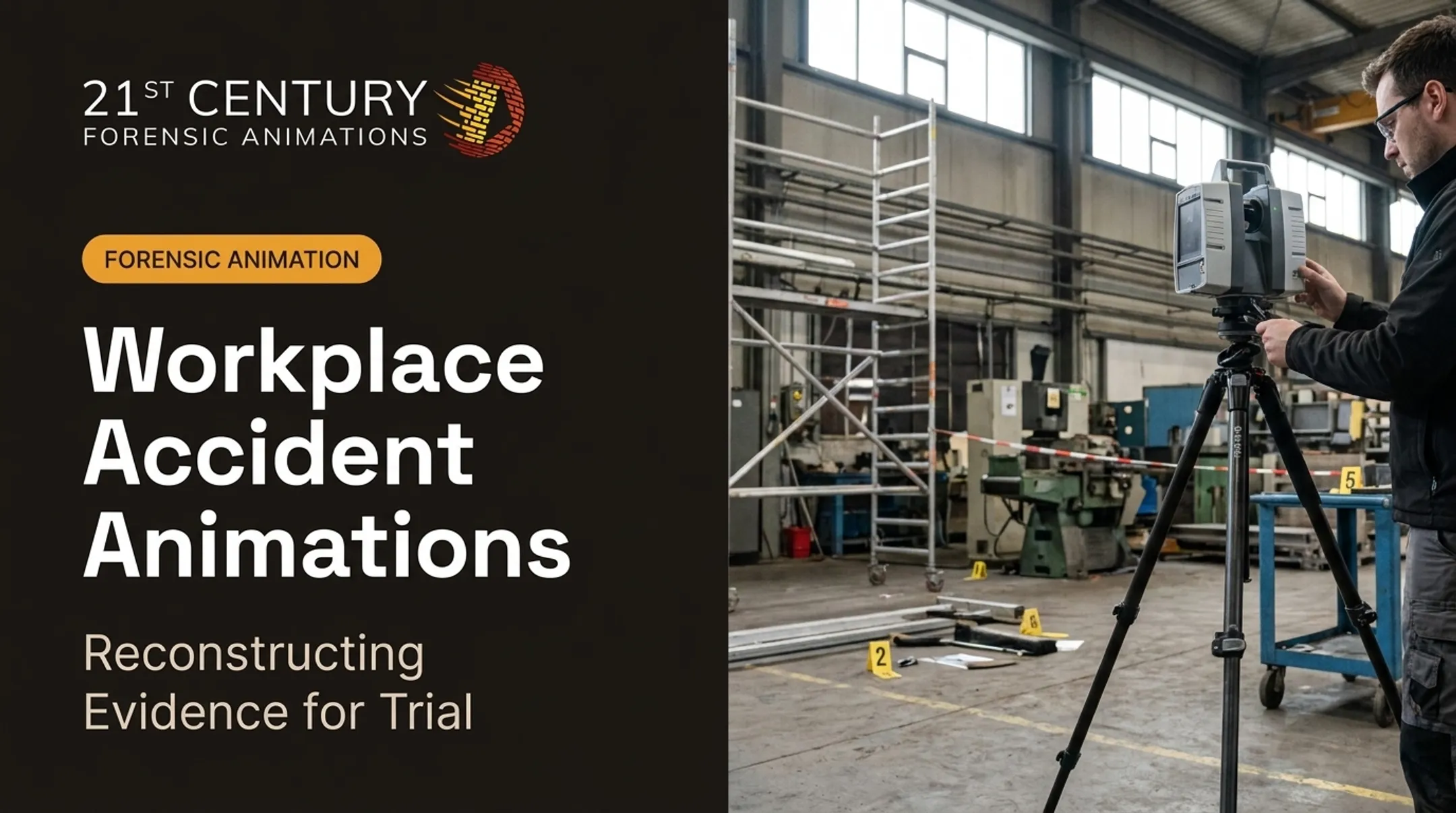
Laser scanning captures millions of precise spatial measurements of the physical scene, producing a point cloud that supports both analysis and 3D modeling.
Drone photogrammetry adds hundreds to thousands of overlapping aerial images, stitched into an accurate 3D model of the larger environment, whether that's a Strip intersection, a parking structure, or a hotel porte-cochère.
According to National Institute of Justice testing, independent research on aerial documentation methods found measurement errors under controlled study conditions. These errors measured as tight as 1 millimeter for terrestrial laser scans and roughly 1 centimeter for aerial photogrammetry.
Actual tolerances vary by project, which is why validation on each specific scene matters more than any blanket accuracy claim.
Physics Validation and Documentation
Every animation frame has to trace back to physical evidence, not assumption. This means:
- Cross-checking vehicle speeds against crush damage and skid mark measurements
- Validating trajectories against physical evidence like debris fields and final rest positions
- Documenting every input, assumption, and calculation used to build the exhibit
Complete methodology documentation is what separates an exhibit that survives cross-examination from one that gets excluded. Nevada hasn't formally adopted Daubert, though Daubert reasoning can be persuasive under Hallmark's NRS 50.275 framework, meaning attorneys still need a paper trail showing the science holds up.
Final Deliverables
Depending on the case, deliverables can include:
- Courtroom-ready 3D animations
- Static exhibits for depositions or mediation
- Interactive VR-ready models jurors can navigate from any angle
The reconstructionist or animator frequently needs to testify to authenticate the exhibit. That's why in-house expert testimony capability, rather than outsourcing to a third-party witness, matters so much when deadlines are tight.

Case Types in Las Vegas That Benefit from Forensic Reconstruction and Animation
Las Vegas's economy shapes the kinds of cases that show up in local courts.
Motor vehicle and pedestrian cases dominate the docket. Strip-corridor collisions, rideshare pickup incidents, and valet-zone accidents all require reconstruction that accounts for pedestrian density and unfamiliar-driver behavior patterns.
Criminal defense and officer-involved shooting cases need a different skill set: ballistics trajectory analysis and kinematic reconstruction of where each person stood and moved during the incident. LVMPD's own use-of-force reporting confirms this occurs regularly, with multiple fatal officer-involved incidents logged annually.
Beyond crashes and shootings, premises, product liability, and fire/explosion cases are common given the density of hotels, casinos, and entertainment venues. Nevada case law reflects this reality: in Humphries v. New York-New York Hotel & Casino, the Nevada Supreme Court applied NRS 651.015's foreseeability framework to a patron-attack claim, reversing summary judgment for the casino.
Hotel fires raise similar causation questions. The Westgate incident, attributed to an accidentally discarded cigarette, illustrates the kind of dispute that benefits from computational fire and smoke modeling.
Why Attorneys Trust 21st Century Forensic Animations for Las Vegas Cases
21st Century Forensic Animations has operated as an independent forensic animation firm since 1989, making it the oldest firm of its kind in the industry. Thirty-seven years of translating complex physical evidence into precise 3D visualizations means the firm has seen nearly every evidentiary challenge attorneys can throw at an exhibit.
Every animation the firm produces is built to be dimensionally accurate and constructed to meet the rules of evidence in any jurisdiction, including state and federal courts. That matters for Las Vegas cases specifically, where exhibits need to satisfy Nevada's NRS 50.275 framework alongside any federal standards that apply.
Full-service technical capability includes:
- Laser scanning producing dimensionally accurate point clouds
- Drone imagery and aerial photogrammetry for large-scale scene documentation
- Close-range photogrammetry for surveillance footage and dashcam video
- Complete methodology documentation prepared for cross-examination
That technical range underpins a portfolio spanning 13 or more case types, civil and criminal, domestic and international. That range includes a documented capital murder case involving bullet trajectory and wound position analysis, a five-vehicle road rage collision reconstruction, and an electrocution liability case built from laser-scanned power line placement data.
Attorneys working under tight trial deadlines benefit from a firm built around responsiveness:
- 24/7 availability backed by a track record of meeting every deadline, no exceptions
- A free consultation for first-time clients
- In-house expert witness testimony, not outsourced, giving attorneys one partner from evidence collection through verdict
How to Choose the Right Forensic Animation Partner for Your Las Vegas Case
Not every vendor claiming forensic expertise can survive a Daubert-style challenge. Before hiring one, run through this checklist:
- Verify independence and objectivity. An in-house or biased vendor creates a credibility problem the moment opposing counsel starts cross-examining methodology. Favor firms with a proven track record of courtroom-tested exhibits.
- Check technological capability. Confirm the firm actually owns and operates 3D modeling, laser scanning, and drone photogrammetry equipment, and ask for transparency around the methodology behind each exhibit.
- Confirm expert testimony availability. An animation is only as strong as the witness who can authenticate it under oath. Ask whether testimony is in-house or outsourced.
- Assess responsiveness. Trial prep timelines don't bend for vendor delays. Firms offering 24/7 access and a demonstrated history of hitting deadlines reduce that risk considerably.

A firm that checks all four boxes gives an attorney far more settlement leverage than one offering polished visuals with no documented methodology behind them. 21st Century Forensic Animations has met this standard since 1989, backing every exhibit with in-house testimony, 24/7 support, and documented methodology.
Frequently Asked Questions
What is the difference between accident reconstruction and forensic animation?
Reconstruction is the scientific analysis that determines the physical facts of what happened. Animation is the visual exhibit that demonstrates those already-established facts for judges and juries.
Is forensic animation evidence admissible in Nevada courts?
Admissibility depends on dimensional accuracy and documented methodology meeting Nevada's evidentiary standards under NRS 50.275. Exhibits built on verifiable data with a clear paper trail have the strongest chance of surviving challenges.
What types of cases use forensic accident reconstruction in Las Vegas?
Common case types include motor vehicle and pedestrian collisions, rideshare incidents, criminal defense and officer-involved shooting cases, and premises liability matters tied to hotels and casinos.
How much does forensic accident reconstruction and animation cost?
Cost varies based on case complexity, evidence type, and which services are needed (laser scanning, drone imagery, animation, or expert testimony). Request a free consultation for a case-specific estimate.
Can forensic animation be used in criminal defense cases?
Yes. It's used in officer-involved shootings, ballistics trajectory analysis, and kinematic reconstructions for both defense and prosecution teams.
How do I choose the right forensic animation expert for my case?
Look for independence, verifiable credentials, strong technological capability, and in-house courtroom testimony experience. A free consultation is a good way to test all four before committing.