
Search interest in terms like "collision animation" and "how are they created" has climbed steadily as attorneys look for ways to make complex physics accessible without sacrificing accuracy. A 2019 mock-court study found jurors reported better understanding of technical testimony when paired with 3D visuals, though the effect wasn't statistically decisive on its own (Errickson et al., 2019). The takeaway: animations support comprehension, they don't replace proof.
This article covers what collision animations actually are, how they're built from raw evidence to courtroom exhibit, which collision types require different modeling approaches, and what separates an admissible reconstruction from a rejected one.
Key Takeaways
- Collision animations translate skid marks, crush data, and witness accounts into visual reconstructions jurors can actually follow
- Every credible animation traces back to physics-based calculations and verified data, not artistic guesswork
- Vehicle, aviation, pedestrian, and ballistic reconstructions each demand distinct modeling methods
- Court admissibility hinges on methodology transparency, not visual quality
What Is Collision Animation?
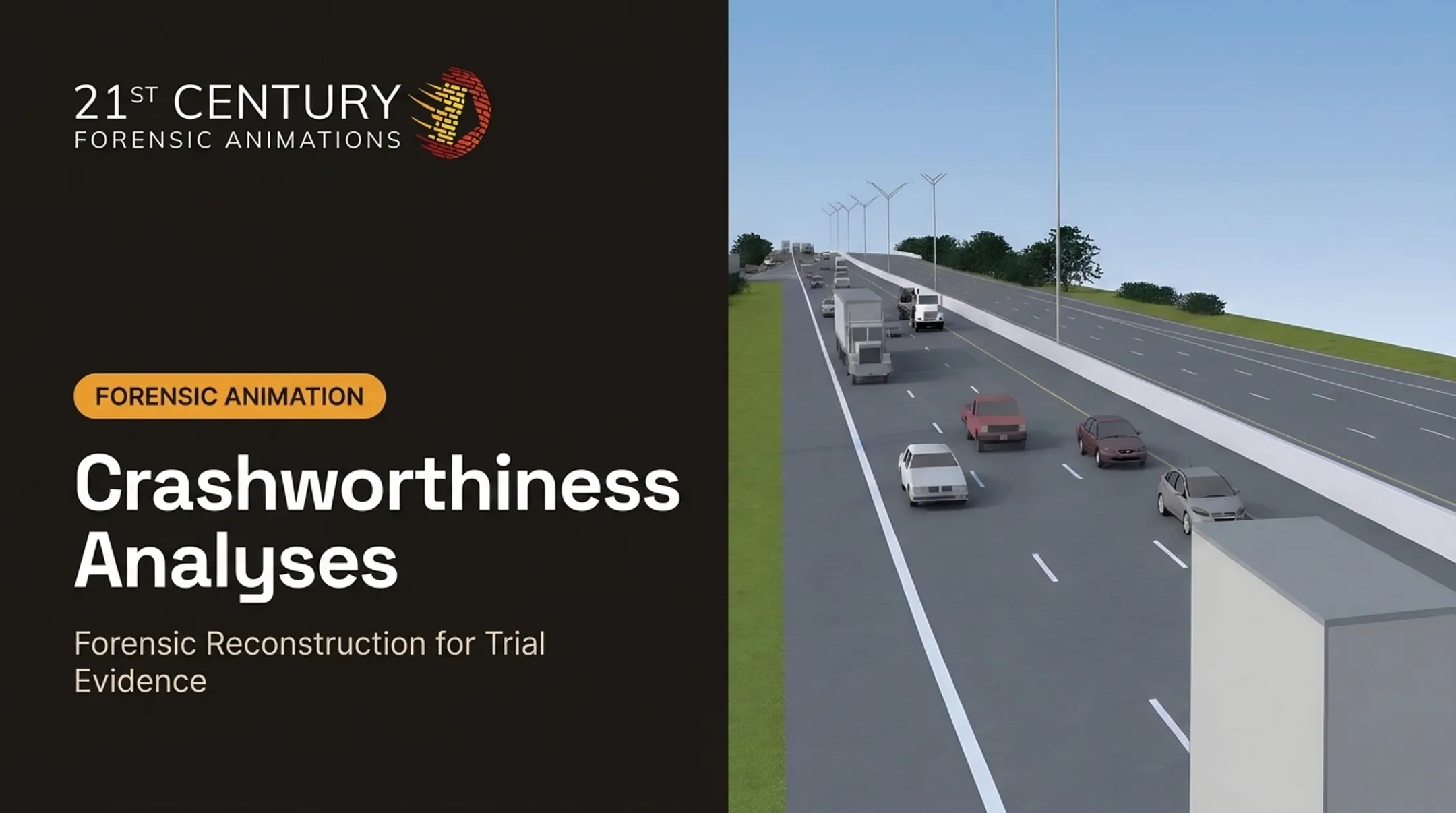
Collision animation is a 3D visualization technique that reconstructs an impact's sequence, speed, and physics using verified case data. It shows a jury or judge what likely happened, frame by frame, grounded in measurable evidence rather than assumption.
Animation vs. Simulation: A Critical Distinction
The terms get used interchangeably, but they serve different evidentiary roles.
Animation is typically demonstrative: a visual aid illustrating a witness's or expert's already-formed opinion. Simulation is typically substantive: a calculated model built from scientific principles that generates the opinion itself.
According to the American Bar Association, this classification matters because simulations face heavier reliability scrutiny than straightforward demonstrative exhibits (ABA Litigation Section).
Calling a calculated reconstruction an "animation" to dodge that scrutiny is a mistake that can sink an exhibit at trial.
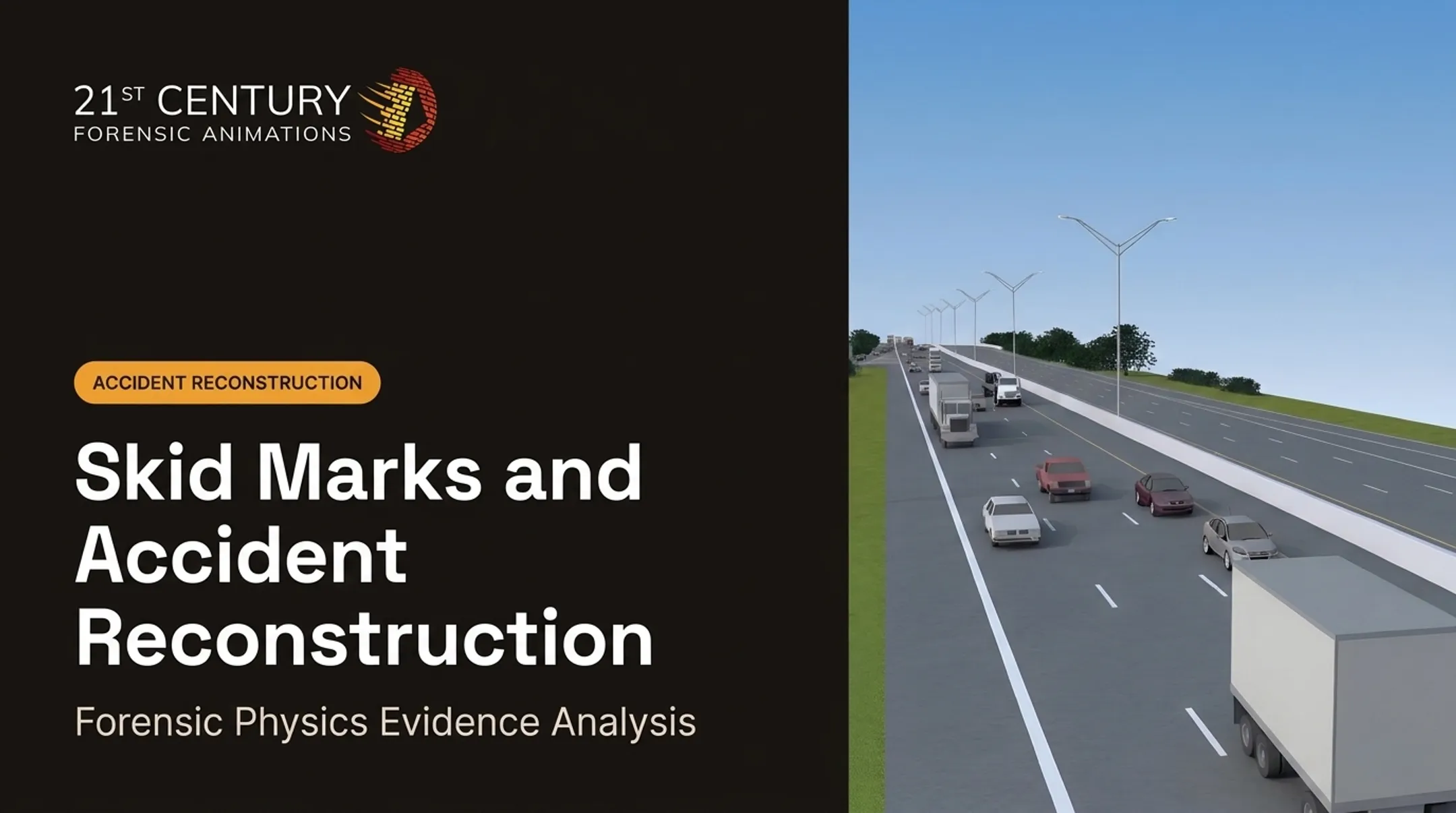
A practical example: A rear-end collision case might combine police report data, measured skid marks, and vehicle damage photographs to determine impact speed and angle. The resulting visual doesn't dramatize the crash; it shows exactly what the underlying measurements support, nothing more.
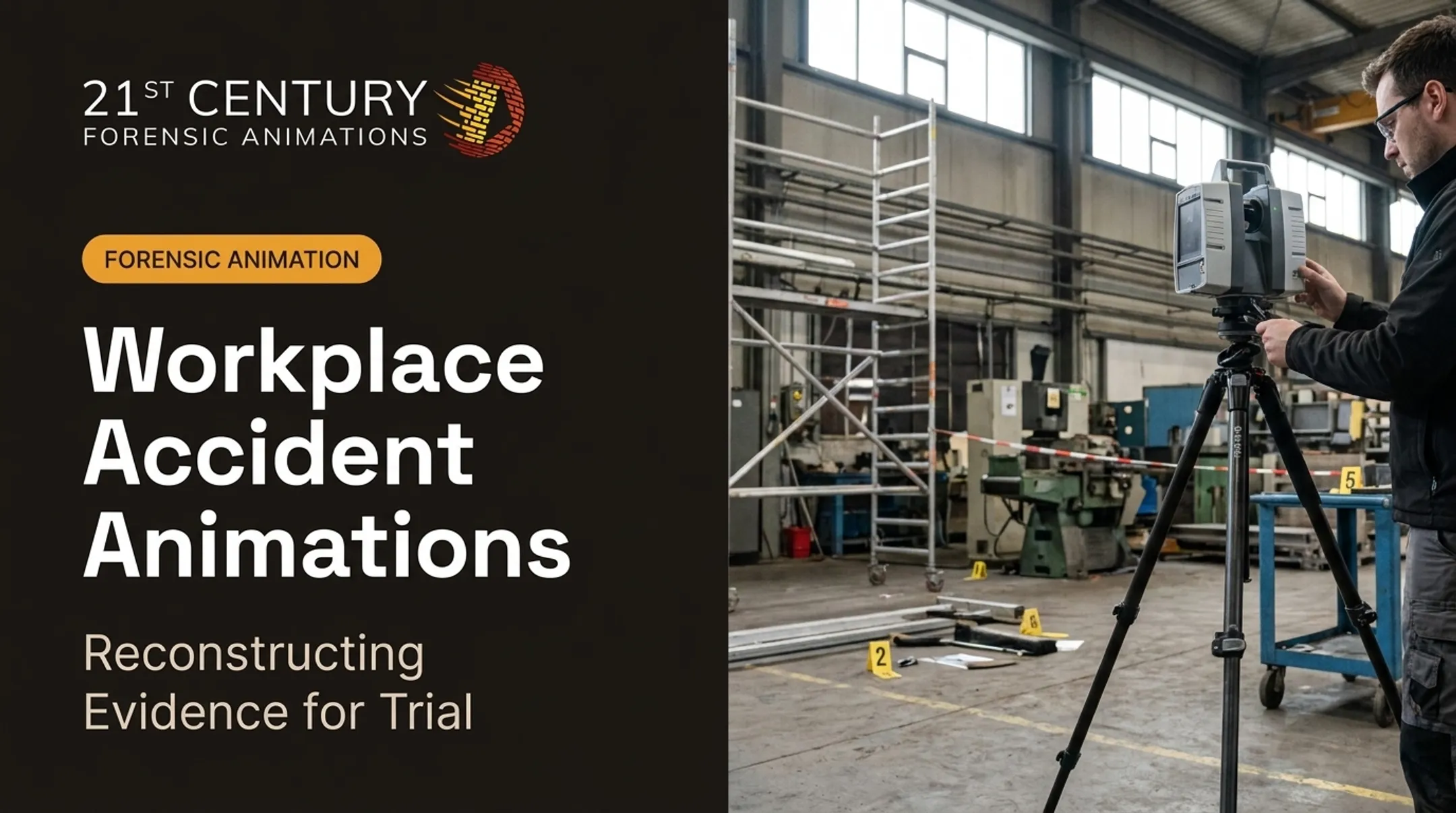
This is where collision animations diverge sharply from Hollywood crash renders. There's no slow-motion glass shatter for effect. Dimensional accuracy is the entire point. 21st Century Forensic Animations builds every reconstruction directly from physical evidence: laser scans, drone imagery, and photogrammetry rather than filling gaps with assumptions.
How Collision Animations and Simulations Are Created
Building a courtroom-ready animation follows a disciplined, evidence-first sequence.
Step 1: Evidence Collection
Analysts gather police reports, Event Data Recorder (EDR) downloads, scene photographs, laser scans, and witness statements. EDRs can capture pre-crash speed, braking, and restraint data, but NHTSA cautions they record only a short window and shouldn't be relied on alone (NHTSA Event Data Recorder).
Step 2: Physics-Based Calculation
Analysts apply established principles, including:
- Conservation of momentum to estimate pre- and post-impact speeds
- Crush analysis comparing vehicle deformation to crash-test benchmarks
- Trajectory calculations for post-impact vehicle or occupant movement
Step 3: 3D Modeling
Analysts build vehicles, terrain, and the surrounding environment to scale using CAD software or photogrammetry-derived models. Accuracy here isn't optional. A model that's off by a few inches can undermine the entire reconstruction under cross-examination.
Step 4: Animation and Rendering
Analysts layer the calculated physics data into the scaled 3D scene. The result is a frame-by-frame reconstruction that shows vehicle positions, speeds, and the timing of each collision event.
Step 5: Review and Validation
Analysts cross-check the finished animation against every known data point and document the methodology used to build it. This documentation is what separates a persuasive demonstrative exhibit from evidence that can withstand cross-examination and judicial scrutiny.

Main Types of Collisions Used in Animation
Different collision types demand entirely different modeling expertise. Each scenario needs its own reconstruction approach.
Common categories include:
- Motor vehicle collisions: Rear-end, T-bone, rollover, and multi-vehicle pileups each require distinct momentum and crush calculations. NHTSA's crash classification manual outlines these categories in detail (ANSI D.16-2017).
- Pedestrian and cyclist collisions: Focus shifts to impact trajectory, throw distance, and sightline analysis to determine what a driver could reasonably have seen.
- Aviation and heavy equipment incidents: Modeling adds altitude, velocity vectors, and mechanical failure points. NTSB maintains extensive aviation accident data for this work (NTSB Aviation Query).
- Ballistic and kinematic reconstructions: Used in officer-involved shootings and product liability cases to trace projectile or object paths and establish wound or damage origin.

21st Century Forensic Animations has produced court-admitted work in both lanes, including a five-vehicle road-rage reconstruction and a capital murder case built on bullet-trajectory and wound-position analysis.
Why Forensic Accuracy and Court Admissibility Matter
Courts don't accept animations on visual merit alone. Every jurisdiction — state, federal, criminal, civil, international — has its own evidentiary rules an exhibit must clear before reaching a jury.
Demonstrative vs. Substantive Evidence
The demonstrative-versus-substantive line decides what a jury may treat as proof. Demonstrative exhibits illustrate testimony. Substantive simulations must survive reliability review under standards like Daubert (federal) or Frye (some states). Those reviews examine testing, peer review, error rates, and general acceptance (Daubert v. Merrell Dow, 1993).
In Commonwealth v. Serge, a Pennsylvania court admitted a computer-generated animation only after the physical inputs were established through witness and officer testimony. The jury was explicitly instructed it was not substantive proof.
In Datskow v. Teledyne, a federal court allowed a crash animation to illustrate expert opinion but stripped the voice-over and added cautionary instructions. That kept the exhibit from reading as an exact reenactment.

What this means practically:
- Complete methodology documentation lets opposing counsel and judges verify every data point
- Expert testimony capability is often required to explain and defend the animation under cross-examination
- A visually polished exhibit with no documented methodology is a liability, not an asset
21st Century Forensic Animations builds every reconstruction with full methodology documentation and provides expert testimony support for trial attorneys nationwide. Founded in 1989, it is the industry's oldest independent forensic animation firm.
Where Collision Animations Are Used in Litigation
Collision animations show up across several litigation contexts where juries and judges need a clear picture of physical events:
- Civil litigation — Motor vehicle accidents, product liability, and eminent domain disputes where accurate reconstruction directly affects damages calculations
- Criminal defense and prosecution — Officer-involved shootings, fires and explosions, and cases requiring ballistic trajectory analysis
- Complex or international cases — War crimes and cross-border incidents that must satisfy multiple overlapping legal standards; international tribunals have used digital and spatial evidentiary models in cases tied to sites in Mali
21st Century Forensic Animations works across all these categories — civil and criminal, domestic and international — spanning more than 13 case types.
Choosing the Right Collision Animation Partner
Not every firm offering "3D animation services" understands courtroom evidentiary standards. Vet carefully.
- Decades of case experience across multiple case types, not just automotive work
- Laser scans, drone imagery, and photogrammetry instead of generic stock templates
- Proven ability to hit tight trial production timelines
- Willingness and ability to explain and defend the work on the stand
A free consultation lets attorneys evaluate fit before committing. 21st Century Forensic Animations offers 24/7 intake by phone or online form, with no obligation.
Frequently Asked Questions
What is collision animation and can you give an example?
Collision animation is a 3D visualization that reconstructs an impact's speed, angle, and sequence using verified data. A rear-end collision, for instance, might combine police report data, skid mark measurements, and damage photos to show exactly how the impact occurred.
How do you create collision animations?
Work starts with evidence collection—police reports, EDR data, and scans—then moves into physics-based calculations, scaled 3D modeling, and rendering. A final validation step documents the methodology used.
What types of collisions can animation reconstruct?
Common categories include motor vehicle collisions, pedestrian and cyclist incidents, aviation and heavy equipment accidents, and ballistic or kinematic reconstructions. Each type needs different data and modeling approaches.
How much does a forensic collision animation cost?
Cost varies based on case complexity, evidence volume, and the type of visualization needed. Request a free consultation for a case-specific estimate rather than relying on general pricing assumptions.
Are collision animations admissible in court?
Admissibility depends on jurisdiction, whether the exhibit is classified as demonstrative or substantive, and whether complete methodology documentation and expert testimony support the reconstruction.
How long does it take to produce a courtroom-ready animation?
Timelines depend on evidence complexity and available data. Production is usually scheduled backward from the trial date, so early engagement helps avoid last-minute evidentiary issues.