
That advantage comes with risk. Attorneys routinely confuse "demonstrative evidence" with "illustrative aids" or real evidence, and foundation mistakes can get an exhibit excluded, or reversed on appeal.
This guide breaks down when, how, and where to use demonstrative evidence effectively, including how new Federal Rule 107, effective December 2024, changes the analysis.
Key Takeaways
- Demonstrative evidence must tie to testimony and pass Rule 403's balancing test
- New Rule 107 separates illustrative aids from admissible demonstrative evidence
- Foundation, accuracy, and motions in limine are prerequisites, not afterthoughts
- The best exhibits simplify complex facts without overstating them
- A forensic visualization expert helps exhibits survive evidentiary challenges
When Should You Use Demonstrative Evidence?
Demonstrative evidence earns its place when testimony alone leaves jurors guessing. Complex mechanisms, medical injuries, accident sequences, and multi-step timelines are hard to hold in your head from spoken words. A visual fills that gap.
Effective use typically includes:
- Clarifying a disputed sequence of events
- Simplifying a technical or medical concept for lay jurors
- Illustrating spatial relationships (distances, angles, positions) that words describe poorly
Common misuse includes:
- Creating unfair prejudice through dramatic or emotionally charged imagery
- Misleading jurors with details unsupported by the record
- Substituting a slick visual for proof that doesn't actually exist
- Overstating certainty with visuals more precise than the underlying data
Use should scale with case complexity. A routine two-car fender-bender might only need a simple diagram showing point of impact. But cases involving multiple vehicles, aviation incidents, or officer-involved shootings often justify a full kinematic animation.
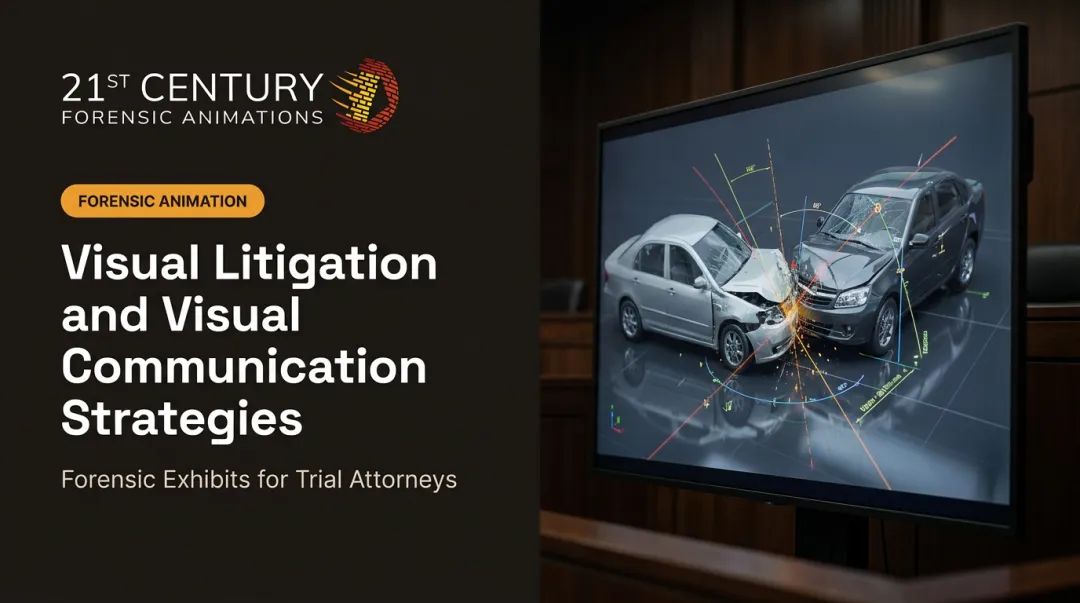
21st Century Forensic Animations' case history illustrates this scaling directly. A 5-vehicle road rage collision required full 3D reconstruction to show the sequencing and spatial relationships across multiple lanes and drivers, something a static diagram can't capture.
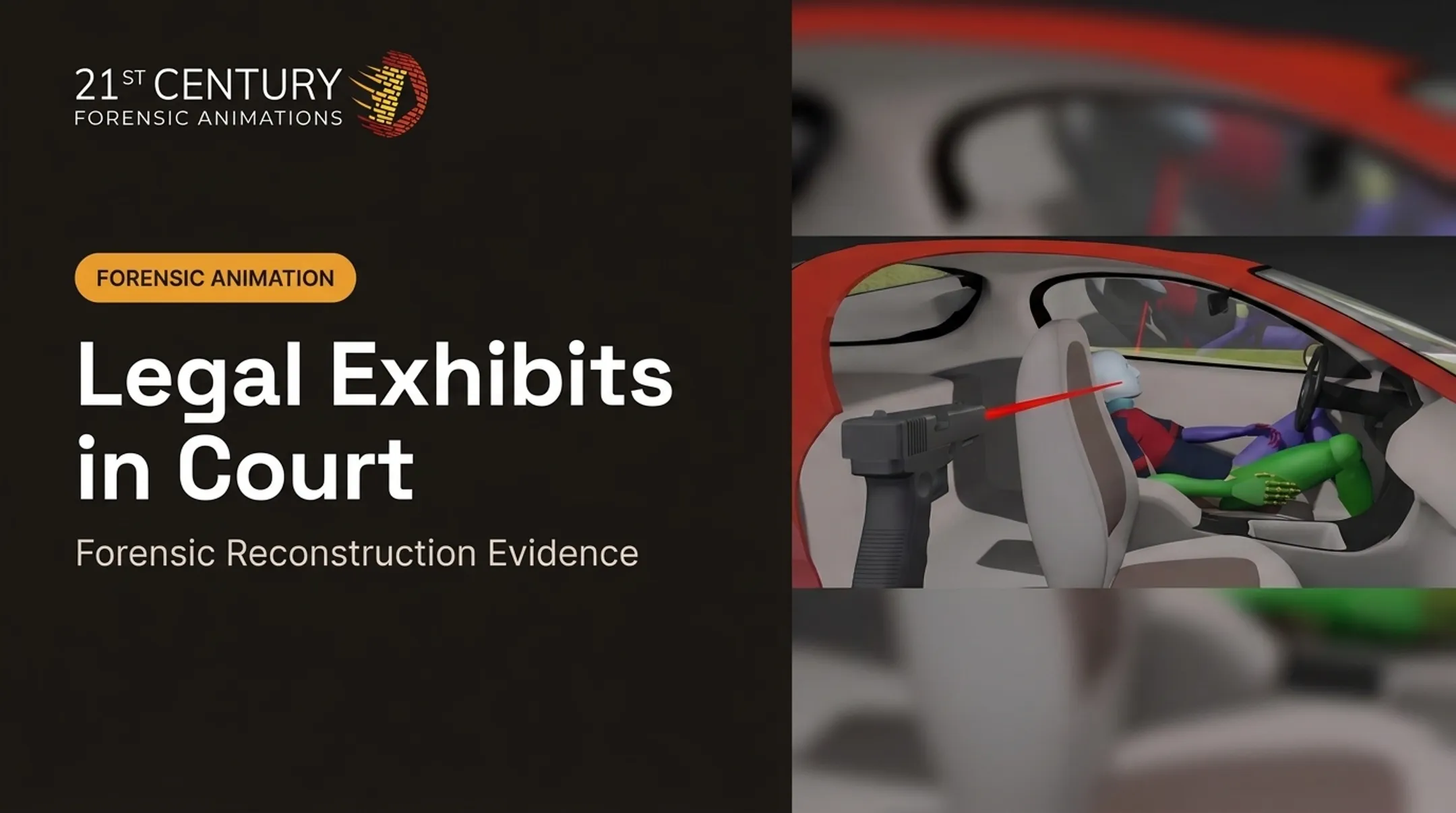
Compare that to a capital murder case involving bullet trajectory and wound position. Kinematic modeling showed the physical relationship between shooter, victim, and projectile path with courtroom-grade precision.

What You Need Before Using Demonstrative Evidence
Before an exhibit ever reaches the jury, it has to clear several hurdles. Skip one, and you risk exclusion mid-trial.
Accuracy and Authentication
An exhibit must be a "fair and accurate representation" of what it purports to show. This is established through source identification and foundation testimony, usually from the witness who created or relied on the exhibit. Rule 901(a) requires evidence sufficient to support a finding that the item is what the proponent claims it is.
The Rule 403 Balancing Test
Probative value must not be substantially outweighed by:
- Unfair prejudice
- Confusion of the issues
- Misleading the jury
- Undue delay or wasted time
Illustrative Aid vs. Demonstrative Evidence
This distinction now carries real weight. Under Rule 107 of the Federal Rules of Evidence, effective December 1, 2024:
- Illustrative aids help the jury understand evidence or argument but are not evidence themselves, and generally can't go to deliberations
- Demonstrative evidence is admitted substantively to prove a disputed fact, and typically does go to the jury room
Get the classification wrong before trial, and you'll find out the hard way what jurors can and can't take with them during deliberations.
Pretrial Motions and Complex Exhibit Documentation
Seeking pretrial rulings through motions in limine avoids disruptive objections mid-trial and often clears the way to use an exhibit during opening statement, not just direct examination.
Technically complex exhibits, like 3D animations or simulations, also need documented methodology and an expert witness who can testify to the underlying data and process.
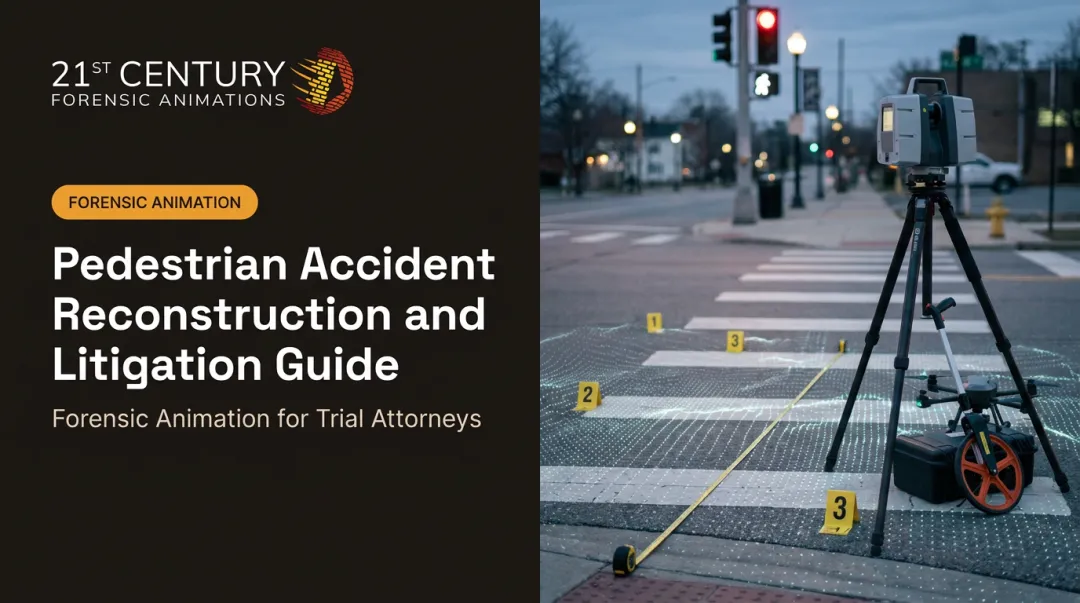
21st Century Forensic Animations builds every animation on objective, verifiable data, whether from terrestrial laser scanning, drone imagery, or close-range photogrammetry. Complete methodology documentation is available to support foundation testimony.
How to Use Demonstrative Evidence at Trial (Step-by-Step)
Attorneys who follow a defined sequence, from selection through preservation of the record, avoid the most common admissibility pitfalls.
Selecting the Right Type of Exhibit
Match the exhibit to the fact you're proving:
- Photos or x-rays for injuries
- Diagrams or models for anatomy or mechanisms
- Timelines or charts for sequences of events
- 3D animations for complex motion or spatial reconstruction, such as vehicle crashes, shootings, or explosions
The most common error? Choosing an overly dramatic or complex exhibit that invites a Rule 403 objection when a simpler exhibit would have proven the same point just as well.

Laying the Evidentiary Foundation
Foundation requires a fact or expert witness to confirm the exhibit fairly and accurately depicts what it purports to show. In Robinson v. Missouri Pacific Railroad Co., the Tenth Circuit affirmed use of a scale-model animation after the expert explained exactly how he built it from physical evidence, photographs, and site measurements.
Computer animations and simulations typically need an expert who can walk through the underlying data, methodology, and software. This is why complete methodology documentation, paired with an expert prepared to testify to it, matters more than the polish of the final render.
Presenting Exhibits and Preserving the Record
Attorneys commonly introduce exhibits during:
- Opening statement (if pre-approved by the court)
- Direct examination (tied to live witness testimony)
- Closing argument (to reinforce the theory of the case)
Signs of proper use: counsel marks the exhibit for identification, shows it to opposing counsel first, and ties it explicitly to testimony as it's displayed, not just flashed on a screen.
Once the exhibit is admitted, be ready to defend it. Common objections include lack of foundation, unfair prejudice, and hearsay. Respond in real time by pointing to the sponsoring witness's testimony and the exhibit's documented source.
Under Rule 107(c), attorneys must enter the illustrative aid into the record when practicable. Failing to do so can jeopardize appellate review later, since there's nothing in the record to show what the jury actually saw.
Where Demonstrative Evidence Is Commonly Used in Practice
Usage patterns shift with case type. Personal injury and motor vehicle cases often rely on diagrams and photos. Product liability, aviation, and officer-involved shooting cases increasingly require advanced 3D reconstructions.
Case types where precise, physics-based visualization is now expected by courts include:
- Motor vehicle accident reconstruction
- Aviation incident reconstruction
- Ballistics and kinematics
- Fire and explosion origin analysis
- Officer-involved shootings
- Eminent domain disputes
- Electrocution and energy provider liability
Firms with deep, cross-case experience bring particular credibility to this work. 21st Century Forensic Animations has spent 37 years translating complex physical evidence into court-ready visuals across 13+ case types, from motor vehicle accidents to war crimes tribunals, domestically and internationally.
Their portfolio includes an electrocution case where power line placement was derived directly from laser scan data, revealing a documented 24-foot overhang relative to a residential structure. That level of precision would be impossible to achieve with a hand-drawn diagram.
Best Practices for Using Demonstrative Evidence Effectively
A handful of habits separate exhibits that survive scrutiny from ones that get excluded.
- Prioritize accuracy over drama. Every visual should be grounded in verifiable data, physics, and documented methodology, not dramatization for its own sake.
- Keep exhibits simple. Overly detailed graphics often confuse jurors rather than helping them understand the point you're making.
- Test technology beforehand. Run-throughs before trial ensure equipment and files perform smoothly when it matters.
- Seek pretrial admissibility rulings. This avoids mid-trial disruptions and objections that break your momentum in front of the jury.
Working with an experienced, court-tested forensic animation firm makes these practices easier to execute. 21st Century Forensic Animations, founded in 1989 as the industry's first independent forensic animation firm, provides complete methodology documentation and expert testimony support. This groundwork helps exhibits withstand evidentiary challenges in any jurisdiction.

Effective demonstrative evidence demands accuracy and precise timing as much as visual clarity. Get both right, and jurors understand the evidence, retain it, and trust the attorney presenting it.
Frequently Asked Questions
What is demonstrative evidence?
Demonstrative evidence is a representation used to illustrate or explain testimony rather than serve as direct proof. A common example is an accident diagram showing vehicle positions.
How does demonstrative evidence differ from real and substantive evidence?
Real or substantive evidence was actually part of the incident and has independent probative value. Demonstrative evidence is created afterward solely to clarify testimony.
What are the 4 types of evidence?
The four types of evidence are:
- Testimonial – a witness's account
- Real or physical – tangible items from the event
- Documentary – records such as writings or photos
- Demonstrative – created to illustrate facts already in testimony
Is demonstrative evidence admissible in federal court?
Admissibility depends on satisfying Rule 403's balancing test, establishing proper foundation, and correctly classifying the exhibit under the new Rule 107.
What is the difference between demonstrative evidence and an "illustrative aid" under new Rule 107?
Illustrative aids assist jury comprehension but aren't entered as evidence. Demonstrative evidence is formally admitted to substantively prove a disputed fact.
Can jurors take demonstrative evidence into deliberations?
Illustrative aids generally cannot go to the jury room unless all parties consent or the court orders otherwise. Admitted demonstrative evidence usually can, subject to the court's discretion.