
Introduction
A cyclist hit by a car rarely walks away with a clean story. Police arrive, take a few photos, jot down statements, and file a report that often misses half the picture.
Bicycles don't leave the same skid marks or crush patterns as cars, and many responding officers simply weren't trained to read them.
That gap matters. NHTSA reports 1,166 pedalcyclists killed and an estimated 49,989 injured in U.S. traffic crashes in 2023 — an 8% jump from the previous year, according to NHTSA's 2023 Traffic Safety Facts report on bicyclists.
When fault is unclear, injured cyclists lose leverage in settlement talks and at trial. Bicycle accident reconstruction fixes that by replacing guesswork with physics and documented evidence.
Key Takeaways
- Bicycle crashes involve dynamics most investigators miss or skip entirely
- Reconstruction blends physical evidence, digital data, and engineering analysis into one narrative
- A six-step process turns scene documentation into trial-ready visuals
- 3D animations turn technical findings into evidence juries can follow
What Is Bicycle Accident Reconstruction?
Bicycle accident reconstruction is the forensic and engineering process of analyzing physical evidence, digital data, and witness accounts to determine how and why a bicycle collision happened. It is used in personal injury litigation, insurance disputes, wrongful death claims, and criminal cases involving vehicular injury or homicide.
Reconstructionists typically work from three evidence streams:
- Physical evidence: roadway conditions, skid marks, bicycle and vehicle damage, paint transfer, debris fields
- Digital and data-driven evidence: GPS units, bike computers, event data recorders, dashcam or CCTV footage
- Witness and testimonial evidence: statements from cyclists, drivers, passengers, and first responders at the scene
Most cases blend all three, then layer in 3D visualization so the findings can actually be presented rather than just described. A written report full of speed calculations means little to a jury without a visual that shows how the numbers translate into what actually happened on the road.
Why Bicycle Accident Reconstruction Is Critical in Personal Injury Litigation
Cyclists start these disputes at a structural disadvantage. Responding officers often default to automobile-crash assumptions (vehicle-style skid distances, standard right-of-way logic) that don't map cleanly onto bicycle dynamics or roadway hazards specific to riders.
The evidence backs this up. A peer-reviewed study of Boston police bicycle-crash records found average missingness above 75% across standardized crash-data fields, according to research published on police narrative reporting gaps. Reports captured crash type reasonably well but consistently dropped details on speed, position, and contributing conditions.
A rigorous reconstruction replaces that gap with an evidence-backed sequence of events. It:
- Establishes fault objectively between driver, cyclist, or a third party like a municipality
- Reduces reliance on incomplete or conflicting eyewitness testimony
- Clarifies causation to support accurate damage and injury claims
- Surfaces overlooked factors, such as roadway defects or illegally parked vehicles blocking sight lines
- Strengthens settlement leverage and trial credibility through defensible methodology
- Gives juries a physics-grounded, visual understanding of how the collision actually unfolded

Without this layer of analysis, cases often boil down to "he said, she said." With it, attorneys have something a claims adjuster or a jury can actually evaluate.
How Bicycle Accident Reconstruction Works — Step by Step
Reconstruction follows a practical sequence, not abstract theory. Most case failures stem from procedure, not analysis. Rushed scene documentation, skipped bicycle mechanical inspections, and delayed retrieval of GPS or bike computer data (which can be overwritten or deleted within days) are the most common ways cases lose critical evidence permanently.
Define the objective. Every case turns on a specific technical question: Was the driver speeding? Could the collision have been avoided? What caused the cyclist to fall? Nailing this down first sharpens investigation scope and case strategy.
Gather physical and digital evidence. This stage collects scene photographs, tire marks, damage documentation, GPS or bike computer data, CCTV and dashcam video, and witness statements. Evidentiary completeness here determines how reliable every downstream calculation will be.
Inspect and document the bicycle and vehicle. Examiners check brakes, tires, frame integrity, and gearing on the bicycle, plus vehicle damage and paint transfer, to pinpoint the exact impact location. This step also rules out pre-existing mechanical defects that opposing counsel might otherwise blame for the crash.
Apply engineering and physics-based analysis. Momentum analysis, crush damage assessment, and biomechanics calculate speed ranges, impact angles, and force distribution. Engineers apply SAE crash-test data on car-bicycle impacts, for instance, to relate striking-vehicle speed to how far a cyclist is thrown, offering a useful cross-check on other speed estimates.
Interpret findings and build the narrative. Analysts translate technical outputs into a coherent sequence of events, then test that sequence against driver, rider, and witness accounts for consistency. This is where causation clarity either strengthens or weakens the liability argument.
Present findings through visualization and testimony. Final findings become court-ready 3D animations, diagrams, and expert testimony built to meet the evidentiary standards of the relevant jurisdiction. This step determines whether the analysis actually lands with a judge or jury.

Bicycle Accident Reconstruction: Example Case Walkthrough
Consider a simplified, generic bicycle-versus-vehicle scenario to see how these steps play out together.
A cyclist is struck at an intersection after a delivery van, parked illegally, partially blocks the bike lane. Here's how the investigation unfolds:
- Scene inspection identifies the improperly parked van protruding into the cyclist's path as a possible contributing factor, a detail a rushed initial report missed entirely.
- Physical evidence review on both the bicycle and the vehicle reveals paint transfer, wheel deformation, and brake wear patterns that help pinpoint the exact point of impact and rough speed range.
- A common mistake surfaces: the cyclist's bike computer sat untouched for three weeks before anyone thought to pull its GPS data. By then, the device had auto-deleted the ride log, permanently limiting how precisely investigators could calculate approach speed.
- Findings are synthesized into a written report paired with a 3D animation depicting the full sequence (van position, cyclist trajectory, and impact point) for use in negotiation or trial. It's the kind of court-ready exhibit firms like 21st Century Forensic Animations build to withstand cross-examination.
The resulting visualization gave both sides a shared, physics-grounded reference point. Instead of arguing over vague eyewitness impressions, negotiations centered on documented evidence, which moved the case toward a faster, better-supported settlement.
How 21st Century Forensic Animations Can Help
Attorneys handling bicycle accident cases need a partner who can turn fragmented evidence into something a jury trusts on sight. 21st Century Forensic Animations has been doing exactly that since 1989.
As the oldest independent forensic animation firm in the industry, the company brings 37 years of experience translating raw reconstruction data into precise, verifiable 3D visualizations.
What that looks like in practice:
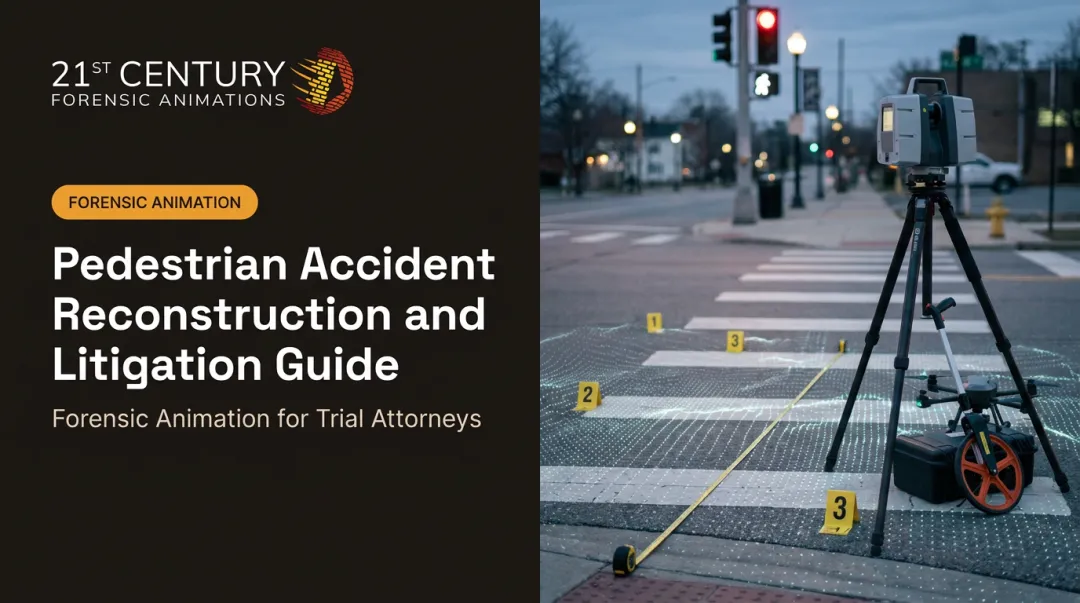
- Court-ready exhibits built on laser scanning, drone imagery, and photogrammetry, engineered to meet rules of evidence across civil, criminal, state, federal, and international jurisdictions
- Complete methodology documentation that stands up against admissibility challenges, whether the courtroom applies Daubert, Frye, or a state-specific standard
- In-court expert testimony paired with 24/7 availability, so tight litigation deadlines don't become a reason to skip proper reconstruction
- A free consultation for first-time clients, available across service areas in Texas, Illinois, and Louisiana

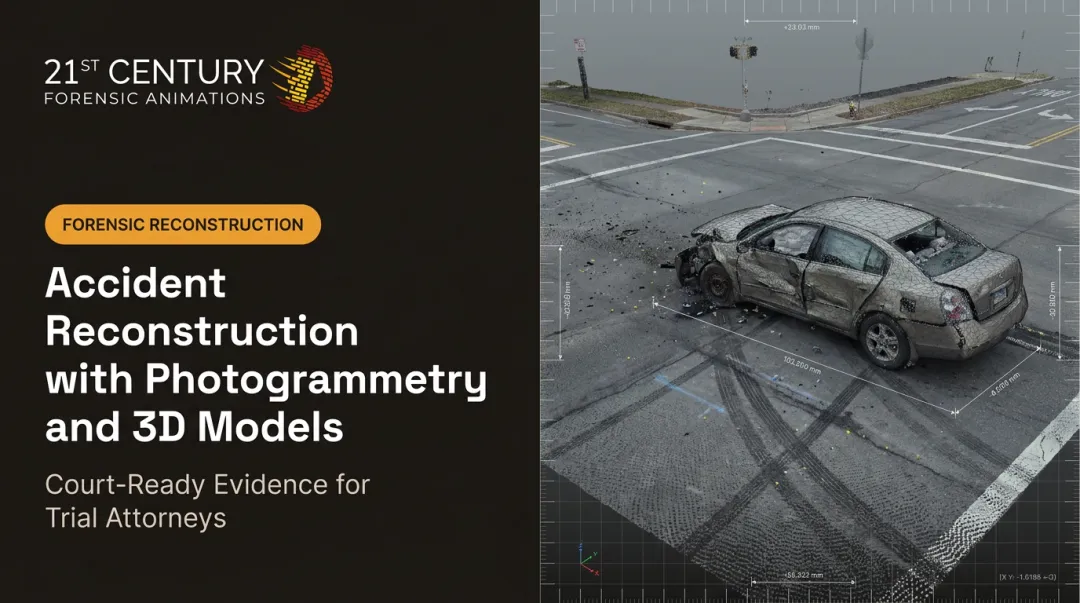
For a bicycle case specifically, that often means combining photogrammetry on dashcam or intersection camera footage with a laser-scanned model of the roadway. The result is an animation that shows sight lines, vehicle positioning, and impact dynamics from any angle a juror needs to see.
Reach the team at (800) 460-2887, any time, day or night, to talk through what a case needs before evidence windows close.
Conclusion
Bicycle accident reconstruction takes fragmented, disputed evidence and turns it into a clear, physics-grounded narrative — one that supports fair liability determinations instead of leaving them to guesswork or an underqualified police report.
The evidence landscape keeps shifting, too. E-bikes now account for a growing share of cycling injuries. The U.S. Consumer Product Safety Commission recorded 155,200 emergency-department-treated e-bike injuries and 310 reported fatalities between 2017 and 2024. Motor vehicle collisions rank among the leading causes, per CPSC's 2024 micromobility hazard report.
As onboard GPS devices, motor controllers, and data loggers become standard on more bikes, reconstruction methods need continual review to keep pace with what that evidence reveals. Skilled forensic animation turns this growing dataset into court-ready visual evidence attorneys can rely on.
Frequently Asked Questions
How long does bicycle accident reconstruction take?
Timelines typically range from a few weeks to several months, depending on evidence complexity, how quickly the scene and vehicles can be accessed, and litigation deadlines. Early engagement gives reconstructionists the best shot at preserving perishable evidence.
What should you not say after a bicycle accident?
Avoid admitting fault, guessing at your speed or the driver's speed, and giving a recorded statement to an insurance adjuster before speaking with legal counsel or a reconstruction expert. Early statements often get used against you later, even when they're just guesses.
Who is at fault if a car hits a bicycle?
Fault depends on traffic laws, right-of-way rules, and what the reconstruction evidence shows. Liability can rest with the driver, the cyclist, or even a third party like a municipality if a roadway defect contributed to the crash.
What evidence is most important in a bicycle accident case?
Scene evidence, bicycle and vehicle damage, GPS or video data, and witness statements form the core evidence base. Losing any one of these categories — especially digital data, which can be overwritten quickly — weakens the overall reconstruction.
Can bicycle accident reconstruction be used as evidence in court?
Yes. Reconstruction findings and animations are routinely admitted as expert testimony or demonstrative evidence, provided the methodology is sound, documented, and meets the jurisdiction's evidentiary standard under Federal Rule of Evidence 702.
How much does a bicycle accident reconstruction expert cost?
Costs vary based on case complexity and how much visualization or testimony the case requires. 21st Century Forensic Animations offers a free initial consultation to help attorneys scope out likely costs before committing.