
That gap between what an attorney knows and what a jury can absorb is where cases get won or lost.
Visual litigation closes that gap. It's the discipline of translating dense evidence, whether medical, technical, forensic, or financial, into visuals that judges and jurors can actually follow and remember. A timeline replaces a stack of dates. A 3D animation replaces a verbal description of how a vehicle left its lane.
This article covers what visual litigation means, why it works, which tools fit which case types, and how to use them strategically and admissibly from opening statement through closing argument.
Key Takeaways
- Visual litigation turns complex evidence into timelines, graphics, and animations jurors retain
- Multimedia research shows visuals paired with narration boost comprehension over text alone
- Tools range from simple callouts to fully rendered animations grounded in physics and data
- Admissibility hinges on accuracy, objectivity, and documented methodology, not visual polish
- Engaging a forensic animation team early boosts clarity and courtroom credibility
What Is Visual Litigation?
Visual litigation is the strategic use of visual evidence and presentation tools, meaning graphics, exhibits, animations, and video, to explain facts, sequences, and expert opinions during pretrial preparation, mediation, and trial. Every visual choice should answer one core question: what does the jury actually need to see to understand this testimony?
Litigation graphics, a closely related term, refer to the demonstrative visuals, including charts, diagrams, timelines, and callouts, used to support testimony and argument. They're distinct from evidentiary exhibits, which are admitted as substantive proof of a fact.
Litigation is the process of resolving a legal dispute through the court system, covering civil and criminal proceedings alike. Visual litigation applies across all of it, including personal injury suits, criminal trials, and administrative hearings.
Demonstrative vs. Evidentiary Exhibits
The distinction matters because it shapes what a visual can and can't do:
- Demonstrative exhibits illustrate or support testimony. They're not proof on their own; they help the fact finder understand evidence already in the record.
- Evidentiary exhibits are admitted as proof of a fact and must satisfy the full evidence rules, including authentication and relevance.
Get this distinction wrong, and a beautifully built animation can get excluded before the jury ever sees it.
Why This Applies Beyond the Courtroom
Visual litigation isn't limited to jury trials. The same timelines, scene reconstructions, and interactive models used at trial also work in mediation, arbitration, and settlement negotiations. A mediator who can see how a collision unfolded, rather than just read about it, often reaches a resolution faster. Arbitration panels, too, benefit from the same clarity a jury would need.
The Science Behind Visual Communication in the Courtroom
Jurors sit through days, sometimes weeks, of technical, medical, or financial testimony. Unsupported verbal testimony alone is easy to forget. Ask any trial attorney what happens when an expert spends 40 minutes describing metallurgical fracture patterns with no visual aid , most jurors lose the thread within minutes.
Educational research backs this up. In a review of 13 separate studies on the multimedia principle, learners who received words paired with pictures outperformed learners who received words alone on every single test, with a median effect size researchers describe as large (Mayer, Cambridge Handbook of Multimedia Learning).
That's not a courtroom-specific number, but it reflects the same cognitive mechanics jurors rely on when processing trial testimony.
Where Visuals Matter Most
Visuals are especially critical in technical case types where physical dynamics are nearly impossible to describe in words alone:
- Motor vehicle accidents: speed, angle of impact, sequence of events
- Product liability: mechanical failure points, defect propagation
- Fires and explosions: heat spread, ignition sources, structural collapse
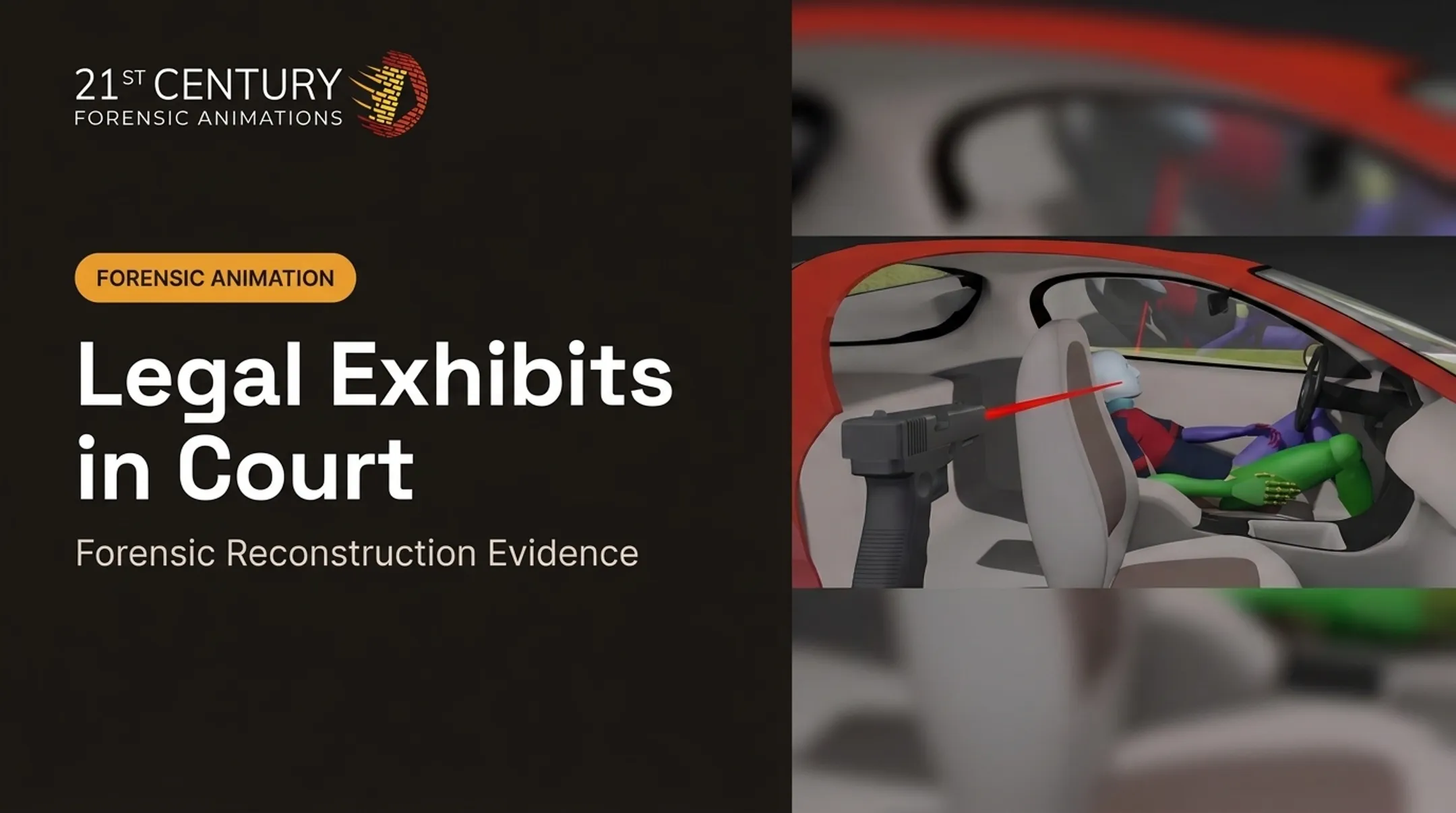
- Ballistics: bullet trajectory, wound positioning, shooter location
A well-built visual gives jurors a shared reference point they can return to throughout testimony, which reduces the cognitive load of tracking multiple witnesses across multiple days. It also carries an emotional dimension — a scene reconstruction or injury diagram can humanize evidence without sacrificing objectivity, so long as it stays grounded in fact.
Courts have recognized this influence for years. In Commonwealth v. Serge, the Pennsylvania Supreme Court upheld a 3D computer-generated animation used to illustrate a prosecution expert's opinion on bullet trajectories and body positioning, finding it properly authenticated, relevant, and not unfairly prejudicial (The Sedona Conference).
The court treated it as demonstrative evidence supporting expert testimony, not as an independent scientific conclusion. That distinction still shapes how animations get admitted today.
Types of Visual Litigation Tools and Strategies
Not every case needs a full 3D reconstruction. Matching the tool to the case is half the strategy.
| Tool | Best suited for |
|---|---|
| Timeline | Contract disputes, chronological fact patterns |
| Charts and graphs | Financial damages, statistical comparisons |
| Diagrams | Anatomical injuries, mechanical processes |
| Document callouts | Highlighting key contract language or medical notes |
| Physical/digital exhibits | Objects, photographs, scale models |
Forensic Animation and 3D Reconstruction
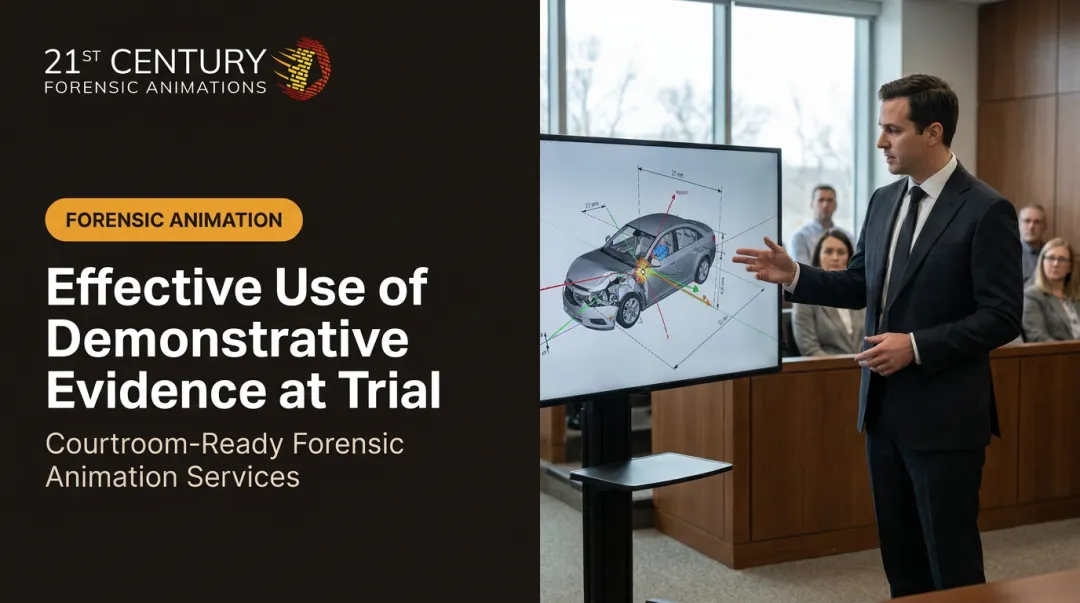
At the most advanced tier sits forensic animation and 3D reconstruction, used to recreate accident sequences, ballistics trajectories, or scene events frame by frame. What separates a defensible animation from a cartoon is the data underneath it:
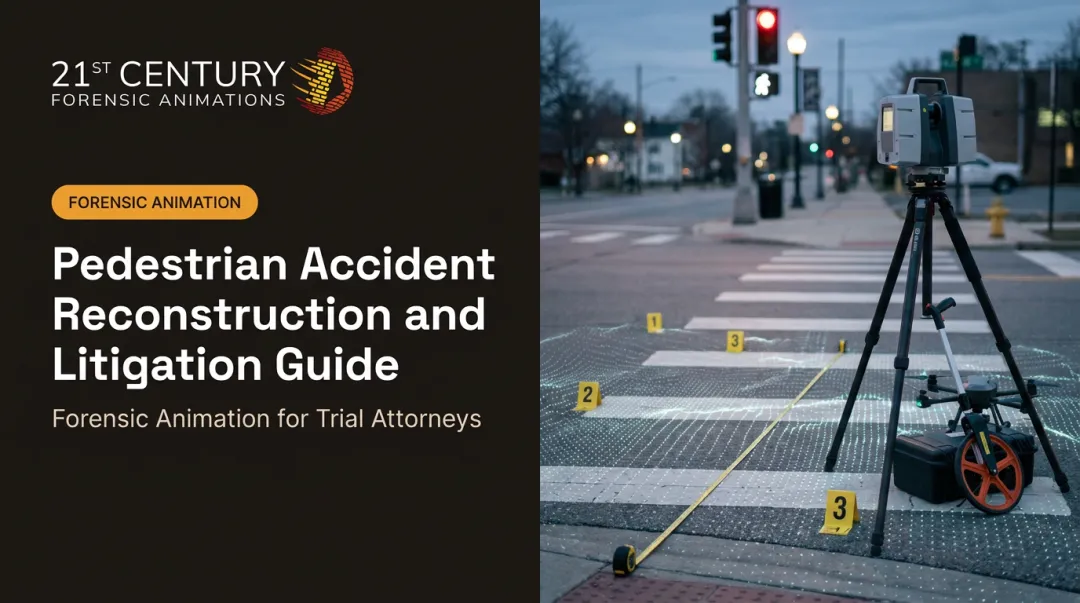
- Laser scanning captures millions of precise spatial measurements, producing point cloud data accurate to the millimeter
- Drone imagery documents large-scale scenes through hundreds or thousands of overlapping aerial images
- Photogrammetry extracts 3D measurements directly from photographs or existing footage, including dashcam and surveillance video

These methods ground a visualization in verifiable measurement rather than artistic interpretation: the difference opposing counsel will look for on cross-examination.
21st Century Forensic Animations builds every animation on this kind of physics-and-evidence foundation, with complete methodology documentation attorneys can point to when challenged.
The firm has worked across 13-plus case types, from motor vehicle accidents and product liability to officer-involved shootings and war crimes. Its exhibits are built to hold up in civil, criminal, state, federal, and international courts alike.
The right tool still depends on complexity. A simple timeline may resolve a contract dispute. A fatal crash or aviation incident usually demands full 3D reconstruction, laser-scanned and photogrammetrically verified.
Looking further ahead, AI-assisted visualization and AR/VR courtroom demonstrations represent the next frontier, though the same admissibility standards still apply. Courts require authentication, accuracy, and a qualified expert who can explain the underlying process. A flashy tool with no documented methodology is still inadmissible.
Using Visual Strategies at Every Stage of Trial
Visual litigation isn't a one-time exhibit dump. It's woven through the entire trial.
Opening Statement
A case timeline or scene visual introduces the jury to the story before any testimony begins. It sets expectations, gives jurors a mental map, and prevents them from feeling lost once witnesses start describing dates, locations, and sequences out of order.
A drone-captured aerial view of the scene, for instance, helps jurors judge distances that photos alone can't convey.
Witness and Expert Examination
Document callouts help fact witnesses walk through emails, contracts, or medical charts without losing the jury's attention. Expert witnesses face a tougher task: translating technical opinions into something a non-engineer can follow while still testifying under oath about the methodology.
A forensic animation recreating a fluid dynamics model of a fire's spread, or a laser scan reproducing an accident scene to the inch, gives jurors that translation without dumbing down the science.
Closing Argument
Attorneys return to the same key visuals shown earlier in trial to reinforce the case theme. Reusing a timeline or animation the jury already recognizes builds consistency and aids deliberation — jurors remember what they saw once, but they remember what they saw three times far better.
Legal Standards: Keeping Visual Evidence Admissible
Courts apply three standards to demonstrative and forensic evidence:
- Accuracy: the visual must reflect verified facts and measurements, not estimation
- Objectivity: presentation must avoid dramatization, exaggeration, or misleading framing
- Expert support: a qualified witness must be able to explain and defend the methodology

Under Federal Rule of Evidence 702, the proponent of expert testimony must show sufficient facts, reliable methods, and a reliable application of those methods to the case. An animation built on guesswork rather than documented measurement fails this test before it ever reaches the jury.
The risk of exclusion is real. Courts have thrown out animations where the factual basis wasn't substantiated, even when the visuals themselves looked polished. A slick reconstruction with no chain of methodology behind it is often worse than no visual at all. It invites objection and costly appeals.
Rules of evidence differ across civil, criminal, state, federal, and international jurisdictions. What passes in a Texas state court may draw a different ruling in federal court or overseas.
A visual litigation partner who understands these differences, and can provide expert testimony to defend the work in court, reduces admissibility risk considerably for out-of-state or cross-border cases. This is where a firm with 37 years of jurisdictional experience, such as 21st Century Forensic Animations, adds real value beyond producing graphics alone.
Best Practices for Effective Visual Litigation
A few principles separate visuals that persuade from visuals that get objected to:
- Build with one purpose. Every visual should tie directly to the case theme — skip decorative detail that doesn't advance an argument
- Simplify without oversimplifying. Strip unnecessary information, but never at the cost of factual accuracy
- Stay consistent. Use the same design language, colors, and terminology across every exhibit so the jury experiences one cohesive narrative, not six disconnected ones
- Test everything early. Courtroom technology fails at the worst moments, so run every visual through the actual equipment well before trial
Attorneys who wait until the week before trial to build their visuals almost always end up cutting corners on the methodology documentation that keeps exhibits admissible in the first place.
Frequently Asked Questions
What are litigation graphics?
Litigation graphics are demonstrative visuals, such as charts, timelines, and diagrams, used to explain evidence and support testimony in court. They illustrate facts rather than serve as independent proof.
What does litigation mean in simple terms?
Litigation is the process of resolving a legal dispute through the court system. It covers both civil matters, like contract disputes, and criminal proceedings.
What is an example of litigation?
A personal injury lawsuit following a motor vehicle accident is a common example. It typically proceeds through discovery, mediation, and possibly a full trial if the parties can't settle.
What makes a visual exhibit admissible in court?
Admissibility depends on factual accuracy, objective presentation, and documented methodology. Courts often require expert testimony to verify how the exhibit was built and what data supports it.
How is forensic animation different from standard litigation graphics?
Forensic animation is grounded in physics, measured data like laser scans and photogrammetry, and expert analysis. Standard litigation graphics, like a simple timeline, don't require that level of scientific foundation.
When should attorneys bring in a visual litigation or forensic animation team?
As early as possible, ideally during discovery. Early involvement lets the visualization team build accurate exhibits that align with case strategy well before trial deadlines close in.