
3D crime scene models trace back further than most people realize. In the 1940s, Frances Glessner Lee built hand-crafted dollhouse-scale dioramas, called the "Nutshell Studies," to train investigators to observe crime scenes methodically. Today's models look nothing like those miniatures. They're built from laser scans accurate to a few millimeters, drone photogrammetry, and physics-based animation software, all designed to survive cross-examination.
This article covers what these models are, how they're built, the reconstruction process behind them, and why they've become essential tools in modern litigation.
Key Takeaways
- 3D crime scene models turn complex physical evidence into visuals judges and juries grasp quickly.
- Modern reconstructions combine laser scanning, drone photogrammetry, and physics-based animation for court-tested accuracy.
- Every element in an admissible model must trace back to verifiable data, not artistic guesswork.
- Documented methodology and testimony-ready experts are essential to getting a model admitted.
What Are 3D Crime Scene Models?
3D crime scene models are dimensionally accurate reconstructions, digital or physical, built from measurements, scan data, and documented evidence rather than assumptions. Every wall placement, bullet path, and vehicle position has to be defensible under questioning.
That standard sets them apart from older training aids. Frances Glessner Lee's Nutshell Studies were miniature dioramas built to sharpen investigators' observational skills. Modern models serve a different purpose: courtroom exhibits designed to meet rules of evidence, so opposing counsel can pick apart the methodology and it still holds up.
Formats vary by case need:
- Static 3D renderings for quick visual reference
- Interactive walkthroughs letting attorneys explore a scene from any angle
- Physics-based animations depicting a sequence of events
- VR-ready immersive exhibits for full spatial navigation

Scanning a Crime Scene: The Foundation of Accuracy
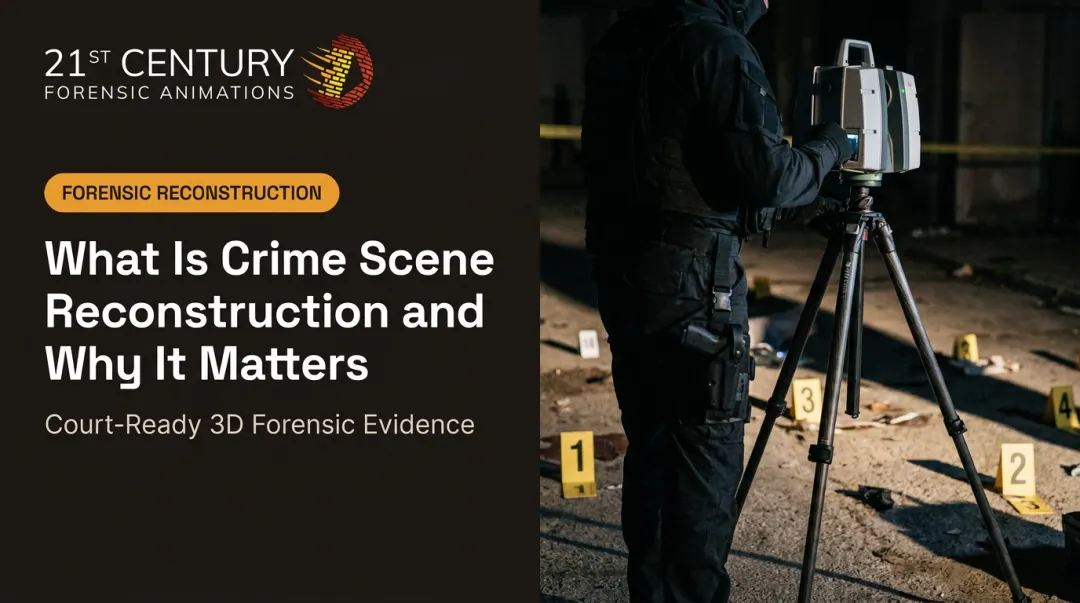
Scanning is where accuracy gets built in, not added later. Laser scanners, drones, and photogrammetry capture millions of data points describing a location's exact geometry.
A 2023 peer-reviewed forensic study comparing photogrammetry against Leica BLK360 point clouds found average measurement differences as low as 0.16%, well within the accuracy margins courts expect.
That scan becomes the skeleton of the model, a digital replica that can be measured and re-verified in court years after the original scene is gone.

From Miniature Dioramas to Digital Reconstruction
Lee's dioramas depicted suspicious deaths in painstaking detail, all built to train investigators to canvass a scene properly. Harvard's Department of Legal Medicine used them in police science seminars starting in 1946, and the Maryland Medical Examiner's Office still uses versions of them for training today.
Investigative scene protocols still echo Lee's original discipline. Alabama's forensic science training module, for example, outlines a seven-step sequence:
- Secure the scene
- Separate witnesses
- Scan the scene
- See the scene
- Sketch the scene
- Search for evidence
- Secure and collect evidence
The exact wording varies by jurisdiction, but the underlying logic hasn't changed in 80 years.
The purpose has shifted. Lee's miniatures taught observation. Today's 3D models are built specifically to answer a legal question: what happened, and can we prove it?
How Modern 3D Crime Scene Models Are Built
Building a courtroom-ready model starts with data collection: laser scanning, drone aerial imagery, and photogrammetry capturing the physical environment down to the millimeter. From there, teams layer physical evidence on top. That includes:
- Bullet trajectories calculated from wound positions and physics
- Blood spatter patterns measured through photogrammetric analysis
- Vehicle damage mapped against crash dynamics
Turning Raw Data Into a Court-Ready Exhibit
Raw scan data doesn't mean anything to a jury on its own. Specialized software converts point clouds and photogrammetric measurements into a navigable 3D environment that attorneys can walk through during depositions or trial. Every step in that process needs documentation, because opposing counsel will ask how each measurement was derived. This is the work 21st Century Forensic Animations has focused on for 37 years: taking objective, verifiable data—laser scans, photographs, and physical evidence—and translating that data into visuals that meet jurisdictional evidentiary standards. Their portfolio includes a five-vehicle collision reconstruction, an electrocution case built from laser-scanned power-line placement, and a capital murder case involving bullet-trajectory and wound-position analysis—all admitted as courtroom evidence. The rule that governs everything here: no artistic interpretation. If a measurement can't be traced back to physical evidence, it doesn't belong in the model.
What Is Crime Scene Reconstruction and Its Five Stages?
Crime scene reconstruction uses physical evidence to recreate the sequence of events at a scene, turning scattered clues into a coherent, defensible theory. Researchers Lee and Pagliaro describe it as the scientific analysis and interpretation of scene-pattern evidence, that ends in a logical conclusion.
While methodologies vary by firm and jurisdiction, reconstruction generally follows this progression:
- Data collection — gathering physical evidence, photographs, scans, and witness statements
- Evidence analysis — examining spatter patterns, trajectories, damage, or debris fields
- Hypothesis formation — building a working theory of what occurred
- Testing and verification — checking the hypothesis against physics and known evidence
- Final reconstruction and presentation — producing the visual exhibit for court

In an officer-involved shooting, that path is concrete. Teams scan the scene and log shell casings, analyze wound trajectories, form a theory of the shot sequence, test it against ballistics data, and produce a multi-angle animation of the encounter.
Documentation at every stage is what separates an admissible reconstruction from an argument. Courts want to see the paper trail, not just the conclusion.
Why 3D Models Matter in the Courtroom
Jurors process spatial information differently than verbal testimony. A 2020 study published in the International Journal of Legal Medicine found that correct comprehension of technical evidence rose from 79% among jurors shown photographs to 94% among those shown 3D-printed models, a meaningful jump in understanding without any change in the underlying facts.

Dimensionally accurate models help judges evaluate admissibility and help juries grasp what words alone rarely convey:
- Distances between people, vehicles, and objects
- Angles of approach, impact, or line of sight
- Timing and sequence of events in complex scenes
In Commonwealth v. Serge (2006), the Pennsylvania Supreme Court admitted a computer-generated animation because it aided jury comprehension without unfair prejudice. The exhibit used no sound effects and no dramatized wounds—only an accurate visual aid tied to expert testimony.
A model is only as strong as the expert who can defend it. When opposing counsel challenges methodology on cross-examination, the firm behind the exhibit must answer clearly, with documentation behind every claim.
Trial schedules don't wait. Attorneys handling civil and criminal matters—from vehicle accidents to officer-involved shootings—need court-tested methods and turnaround that holds under deadline pressure. 21st Century Forensic Animations works on that basis:
- 24/7 availability
- A commitment that every deadline is met
- Free consultations for attorneys weighing whether a case needs a 3D exhibit
Applications Across Case Types
3D crime scene models are used across a wide range of litigation, not just violent crime. Common applications include:
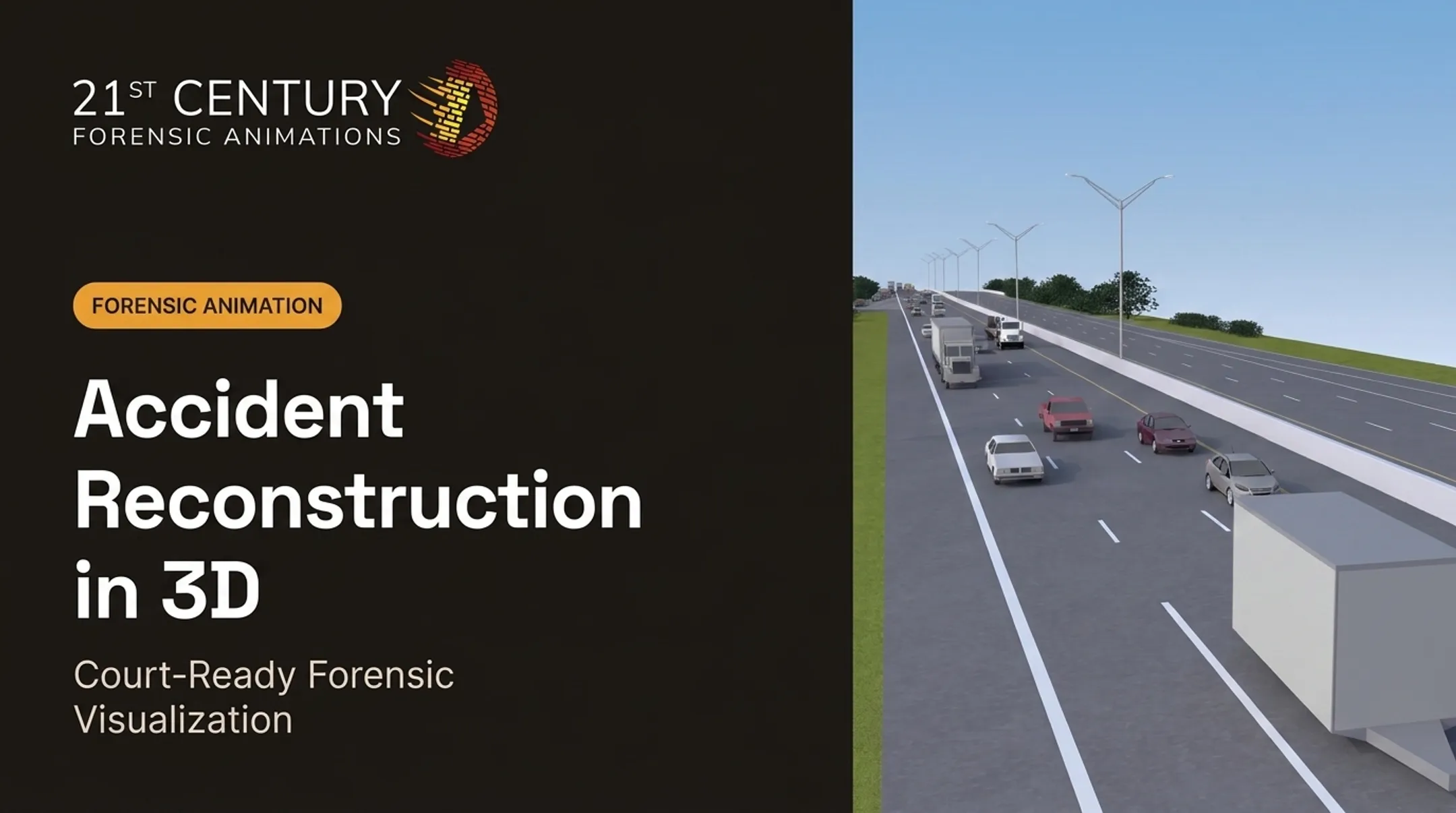
- Motor vehicle accidents — reconstructing crash dynamics and impact sequences
- Aviation incidents — modeling crash sites with laser scanning and drone photogrammetry
- Product liability — showing how a defect caused injury
- Fires and explosions — mapping origin and spread
- Ballistics and kinematics — trajectory and wound-position analysis
- Officer-involved shootings — sequencing rapid, high-stakes encounters
- War crimes — interactive 3D platforms built from satellite imagery, laser scans, and drone footage
- Eminent domain — spatial documentation for property boundaries and valuation
Those same methods show up in high-profile investigative work. The International Criminal Court has used interactive 3D platforms in war crimes proceedings, including cases tied to cultural heritage destruction in Timbuktu. On the aviation side, the NTSB has applied laser scanning and drone photogrammetry to crash sites such as a 2018 helicopter accident near Peach Springs, Arizona.
Attorneys evaluating a firm for this kind of work should look for decades of experience, a track record across criminal defense and civil litigation, and exhibits grounded in verifiable physical evidence.
Frequently Asked Questions
What is scanning a crime scene?
Scanning a crime scene uses laser scanners, drones, and photogrammetry to capture precise spatial data. That capture often yields millions of data points describing a location’s exact dimensions and features for model-building.
What is reconstructing a crime scene?
Crime scene reconstruction uses physical evidence to recreate the sequence of events that occurred and build an evidence-based account of what happened.
What are the five stages of crime scene reconstruction?
The five stages are data collection, evidence analysis, hypothesis formation, testing and verification, and final reconstruction and presentation. Exact terminology varies by firm and jurisdiction.
What are some examples of crime scene reconstruction?
Common examples include officer-involved shootings, motor vehicle collisions, fires and explosions, and ballistics cases involving bullet trajectory and wound analysis.
What are the 7 S's?
A common training sequence is: secure the scene, separate witnesses, scan the scene, see the scene, sketch the scene, search for evidence, and secure and collect evidence.
Why did Frances Glessner Lee create the Nutshells?
Lee built the Nutshell Studies in the 1940s to train investigators to observe crime scenes carefully and take death investigation seriously, using miniature dioramas as hands-on teaching tools.