
This guide breaks down the four key elements of documentation, the "7 S's" workflow investigators use, the tools reshaping the field, and the mistakes that keep undermining otherwise solid cases. For trial attorneys, this isn't just background reading. Documentation quality gets challenged in court constantly, whether you're prosecuting or defending, and understanding its weak points matters either way.
Key Takeaways
- Documentation rests on four pillars: notes, photography, sketches/diagrams, and video/measurements
- The "7 S's" give investigators a systematic field workflow, though terminology varies by agency
- Inconsistencies between photos, notes, and evidence numbers are a recurring courtroom vulnerability
- 3D laser scanning and photogrammetry let investigators capture a scene once and revisit it virtually for trial prep
The Four Key Elements of Crime Scene Documentation
Every credible crime scene record comes down to four components working together: written notes, photography, sketches/diagrams, and video with measurements. Federal guidance from the FBI and DOJ directs investigators to coordinate all four rather than treat them as separate tasks.
Notes and Written Reports
Contemporaneous notes need to include:
- Date, time, and type of crime
- Weather and lighting conditions at the scene
- Names of all personnel present
- A chronological narrative of events as they unfolded The golden rule here is simple: just the facts. NIJ training guidance is explicit that observations "should be based on facts, not opinions." Notes should record the location, appearance, and condition of people and items—not conclusions about what happened. Keep interpretation in a separate, clearly labeled analysis section, not mixed into the raw record.
Photography
Crime scene photography follows a strict sequence: overview, mid-range, and close-up shots.
- Overview — establishes location and context
- Mid-range — ties an item to a recognizable landmark
- Close-up — captures detail, first without a scale, then with one when size matters One rule overrides everything else: never touch or move evidence before photographing it. The photo log is part of that same chain. Record camera settings, the photographer's name, and the time each image was taken—gaps here become easy targets in cross-examination.

Sketches and Diagrams
A proper sketch has to stand as a measured record, not a rough drawing. It needs:
- Case number and crime type
- Scale or measurement method
- Directional references (typically north)
- A legend explaining symbols
- Measurements connecting evidence to fixed points The sketch should stand on its own. Someone who never visited the scene should be able to understand spatial relationships just from reading it.
Video and Measurement Documentation
Video fills gaps that still photos leave behind. It captures spatial flow, movement through rooms, and context a series of static images can't fully convey. Used with photographs and sketches—not instead of them—it helps juries see how spaces connect. Measurement documentation ties those visuals to fixed points and verified dimensions, so later reconstructions rest on the same spatial record. Gaps in any of these four elements give opposing counsel an opening to challenge authenticity, foundation, or credibility. Complete notes, photos, sketches, and measured video leave far less room for that attack.
The 7 S's of Crime Scene Investigation
Beyond the four elements, many agencies train investigators using a field workflow known as the 7 S's. It's a memory aid, not a national legal standard, but it overlaps directly with the documentation principles above.
- Secure the Scene — Establish a perimeter to prevent contamination
- Separate the Witnesses — Get independent statements before accounts can influence each other
- Scan the Scene — Conduct an initial walkthrough to assess scope and hazards
- See the Scene — Identify potential evidence without touching it
- Sketch the Scene — Create the preliminary diagram before anything gets moved
- Search for Evidence — Use systematic patterns like grid, spiral, or zone searches
- Secure and Collect Evidence — Package, label, and log chain-of-custody properly

The exact wording and order of the "S's" can vary by department or training program. Investigators should always defer to their agency's official protocol over any generic list.
Tools and Technology for Modern Documentation
Traditional documentation relied on 35mm SLR cameras, tape measures, and hand-drawn sketches. Modern investigations increasingly use digital cameras, 3D laser scanners, drones, and CADD software instead.
3D laser scanning captures millions of spatial data points, producing a dimensionally accurate point cloud of a scene. Investigators can revisit that virtual scene later for trial prep without needing to return to the physical location.
But it's not a cure-all. NIJ's 2022 comparison of documentation methods found that while 3D videos were preferred by viewers, traditional 2D diagrams and photographs actually produced the highest average accuracy.
Cost is also a factor:
- 3D scanning production: about $852 per minute
- Photography production: about $126 per minute
- Average scanner equipment: $69,000

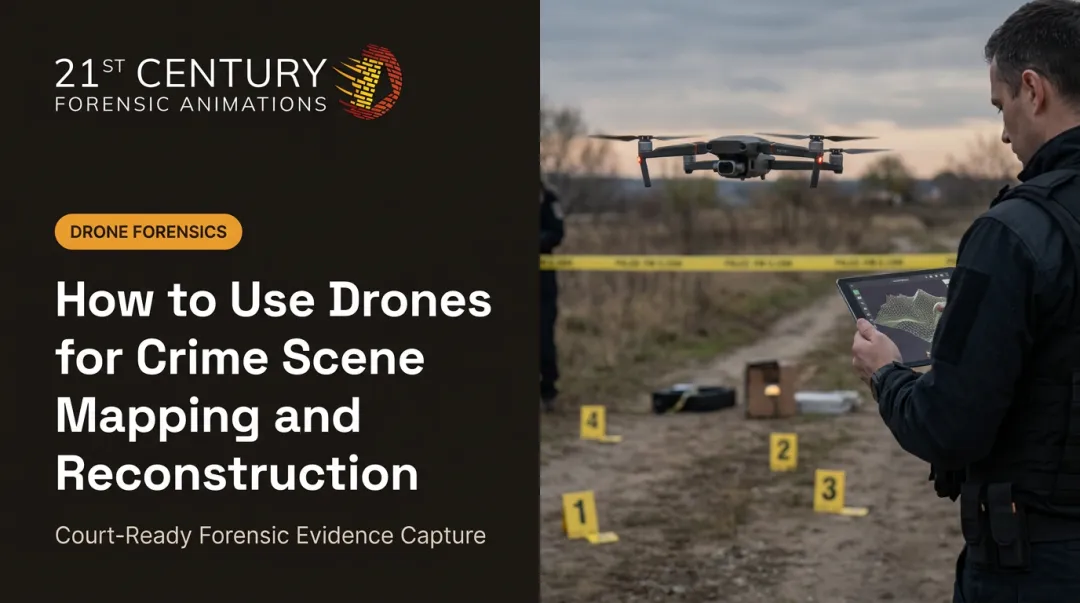
Drone-based photogrammetry has its own tradeoffs. A 2021 NIJ evaluation of aerial systems found that combining terrestrial and aerial scanning produced faster, more accurate results than either method alone, though drones struggled in wooded areas and low-light conditions.
The takeaway: technology supplements the fundamentals. It doesn't replace notes, photographs, and measured sketches.
Common Documentation Mistakes and Courtroom Risks
Three documentation failures show up repeatedly in cross-examination and admissibility fights. Each is preventable with disciplined scene protocol.
Documenting after the scene has already changed. Document first, move evidence later. Once an item shifts position, you can't restore the lost spatial context.
Inconsistencies across records. Conflicting item numbers, timestamps, or photo logs create openings for the defense. Courts weigh these gaps differently depending on severity:
- In McDaniel v. Commonwealth (Virginia, 2021), a challenge to a scene photo's timing went to weight, not admissibility, and the conviction stood.
- In People v. Antunez (New York, 2025), reasonable disclosure efforts were enough to defeat a motion to dismiss over photo evidence.
Incomplete photography. Skipping an overview, mid-range, or close-up is among the most frequent preventable errors. Each shot type serves a distinct evidentiary purpose, and a missing category is hard to fill after the scene is released.
From Scene to Verdict: Turning Documentation into Court-Ready Visuals
Even a flawlessly documented scene can be hard for jurors to interpret from stacks of photos and written reports. Spatial relationships that make sense to an investigator standing in the room often get lost in a two-dimensional courtroom presentation.
Forensic animation and 3D reconstruction solve that gap. Photos, laser scans, sketches, and measurements become dimensionally accurate exhibits built to meet evidentiary standards.
21st Century Forensic Animations, the oldest independent forensic animation firm in the industry, has built these visualizations since 1989. A typical workflow looks like this:
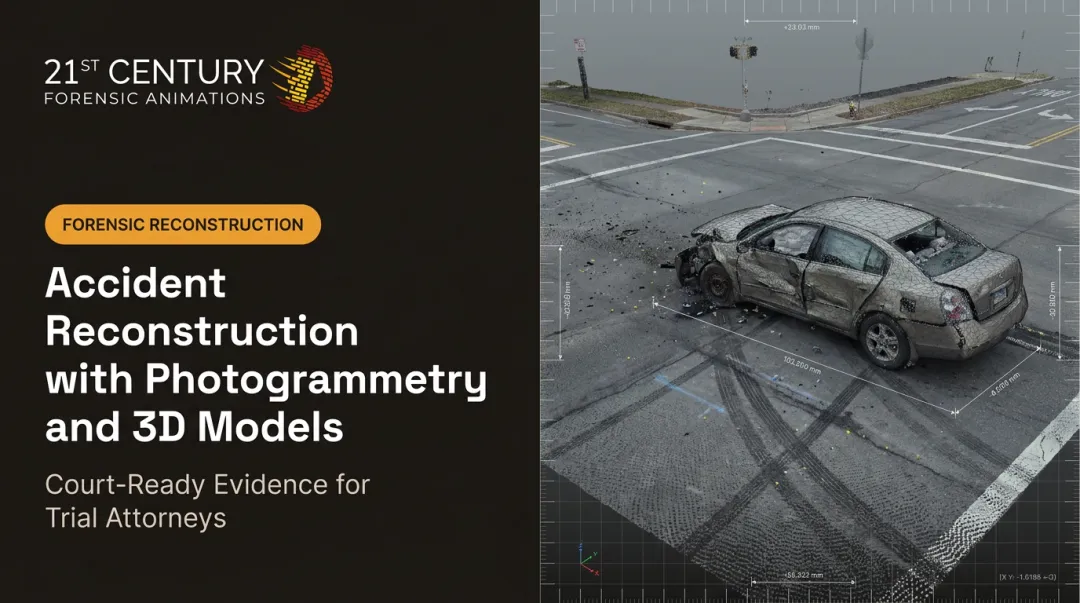
- Photogrammetry pulls 3D measurements from photos and video—skid marks, vehicle damage, trajectories
- Laser scanning builds a dimensionally accurate point cloud from millions of spatial data points
- Physics-grounded reconstruction combines that data with physical evidence and expert analysis
- Final exhibits (animation, static 3D model, or interactive display) ship with full methodology documentation

In one documented electrocution case, the firm derived 3D power-line placement directly from laser-scan data—spatial evidence that still supported reconstruction long after the scene was gone.
If you want to know whether your documentation can support a courtroom visualization, request a free consultation anytime at (800) 460-2887.
Frequently Asked Questions
What are the four key elements of crime scene documentation?
The four elements are written notes, photography, sketches/diagrams, and video. Each covers a distinct piece of the record, and courts expect them to align consistently with one another.
What are the 7 S's of crime scene investigation?
Secure the Scene, Separate the Witnesses, Scan the Scene, See the Scene, Sketch the Scene, Search for Evidence, and Secure and Collect Evidence. Terminology and order can vary by agency.
Why is crime scene documentation important for court cases?
It establishes chain of custody, supports the admissibility of physical evidence, and helps judges and juries reconstruct what happened. Weak documentation gives opposing counsel room to challenge credibility.
What happens if crime scene documentation is incomplete or inconsistent?
Evidence can be challenged on foundation or authenticity grounds, and inconsistencies between records can weaken witness credibility at trial. Courts sometimes treat these issues as questions of weight rather than automatic exclusion.
How has technology changed crime scene documentation?
Departments have moved from film cameras and hand-drawn sketches toward digital photography, 3D laser scanning, drones, and photogrammetry. These tools expand coverage but bring higher costs and do not always outperform traditional methods on accuracy.
Can crime scene documentation be turned into courtroom exhibits?
Yes. Photos, laser scans, and measurements can become 3D animations or interactive models that help jurors visualize complex scenes. Forensic animation firms build these exhibits directly from the underlying documented evidence.