
That data increasingly decides who wins an accident or injury case. But raw numbers rarely convince a jury on their own. A CSV export full of timestamps and coordinates means nothing until someone decodes it, verifies it, and turns it into something a judge or juror can actually follow — while still holding up under cross-examination.
This article breaks down what vehicle forensics covers, the evidence it captures, the biggest obstacles attorneys face when using it, and how 3D visualization technology closes the gap between raw data and courtroom persuasion.
Key Takeaways
- Vehicle forensic data spans EDR "black box" data, GPS/telematics logs, infotainment records, and ADAS output.
- Encryption, proprietary formats, and destructive extraction methods create real recovery risks for litigants.
- Raw data reports rarely persuade juries; visual reconstruction improves comprehension.
- 3D animation grounded in physics cross-validates digital data for defensible conclusions.
- Admissibility depends on documented methodology, not just accurate data.
What Is Vehicle Forensics?
Vehicle forensics is the practice of recovering, analyzing, and interpreting digital and physical data from a vehicle to reconstruct what happened before, during, and after an incident. It draws on EDR modules, telematics systems, infotainment units, and onboard sensors, then places those artifacts against a timeline of events for legal or investigative use.
The field splits into two distinct halves:
- Data recovery: extracting raw information from vehicle modules using specialized diagnostic hardware
- Reconstruction and presentation: converting that raw data into a demonstrative timeline, model, or animation attorneys can use at trial
Why It Matters Across Case Types
Vehicle data now shows up well beyond typical car-crash litigation. It surfaces in product liability claims involving defective braking systems, officer-involved shootings where a patrol vehicle's telemetry contradicts a witness statement, and multi-vehicle collision disputes where drivers offer conflicting accounts.
21st Century Forensic Animations has reconstructed cases like a five-vehicle road rage collision, where physics-based 3D modeling helped establish sequence and causation across multiple impacts. That's the reconstruction side of vehicle forensics at work: taking scattered data points and physical evidence and turning them into a coherent, testable narrative.
Key Evidence Sources Captured by Modern Vehicles
A single vehicle can hold four or five separate evidence streams, each capturing a different slice of the same event.
Event Data Recorder (EDR) data. These modules log pre-crash speed, braking status, throttle position, seatbelt use, and airbag deployment timing, usually across a window of five seconds or less.
NHTSA has estimated that 96% of model-year 2013 passenger cars and light-duty vehicles were equipped with EDRs. That makes EDR data one of the most consistently available sources in modern litigation.
Telematics and GPS data. Location history, acceleration curves, and route data place a vehicle at a specific point in time, which matters enormously in disputed-timeline cases.
Infotainment system data. Paired-device records, call and text logs, and navigation history can tie a driver, passenger, or witness to a specific vehicle at a specific moment.
Sensor and ADAS data. Lane-departure warnings, proximity sensors, and braking-assist logs increasingly establish whether a driver or a system malfunction caused a crash — a distinction that's central to many product liability claims.
None of these sources work best alone. Their real value shows up when layered with physical evidence:
- Scene measurements and laser scans
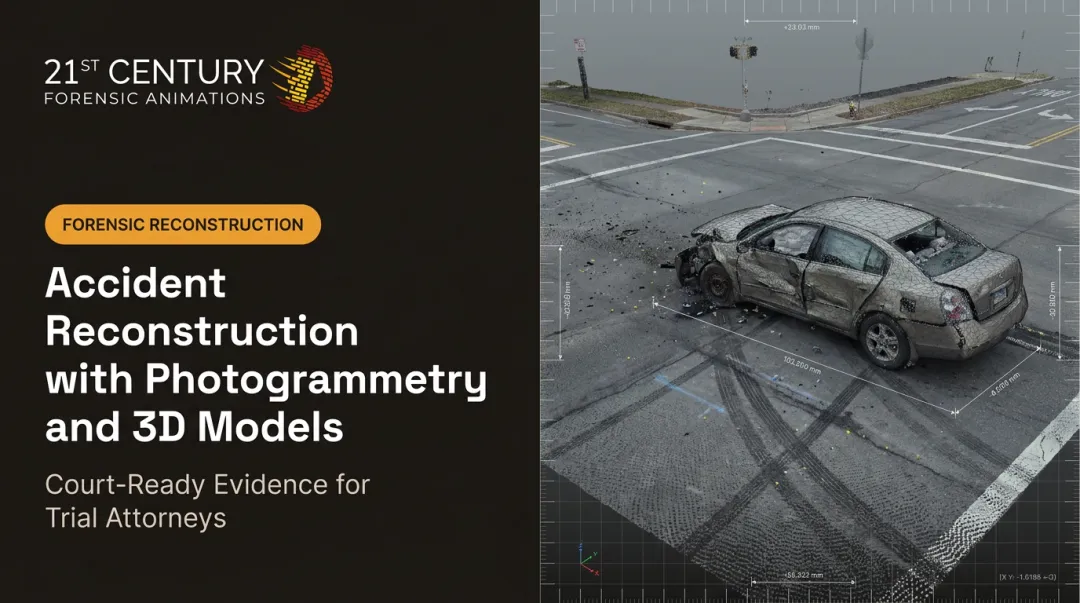
- Photogrammetric analysis of vehicle damage
- Drone-captured aerial documentation
Combining digital logs with physical scene data builds a reconstruction grounded in physics, not just isolated numbers on a spreadsheet.

Top Challenges in Vehicle Forensics Investigations
Getting usable vehicle data in front of a jury involves more friction than most attorneys expect.
Encryption and manufacturer-specific formats. Newer infotainment and telematics systems increasingly encrypt stored data the same way smartphones do. Extraction requires specialized tools, and coverage varies by make, model, and even trim level, so a listed vehicle doesn't guarantee every module is retrievable.
Destructive extraction risk. Older recovery methods sometimes require disassembling a dashboard or physically removing a module. That's a real problem when the vehicle belongs to a victim or a witness who's later cleared of fault.
Data volume and fragmentation. Exported data typically arrives as disjointed CSV logs or coordinate dumps. It's technical, it's dense, and it's nearly impossible for a non-expert (including jurors) to interpret without translation.
Chain-of-custody and admissibility hurdles. Raw digital data must satisfy strict rules of evidence, and those rules differ across civil, criminal, state, federal, and international jurisdictions. Documented, repeatable methodology isn't optional here.
Jury comprehension gap. A peer-reviewed study assigning mock jurors to photographs, 3D digital models, or 3D-printed models in a trauma case found comprehension rates of 79%, 88%, and 94% respectively. Image clarity was strongly associated with juror understanding, the researchers found. Text-heavy data reports simply don't carry that same weight in a jury room.

Overcoming These Challenges with Advanced Forensic Reconstruction Technology
This is where 3D reconstruction earns its keep. Dimensionally accurate models built from laser scans, drone imagery, and photogrammetry translate raw vehicle data (EDR speeds, GPS paths, sensor readings) into a visual timeline anyone can follow, regardless of technical background.
Cross-Validating the Data
Physics-grounded animation doesn't just illustrate a claim; it tests it. Reconciling EDR pre-crash speed against scene evidence and vehicle damage produces an exhibit that's both accurate and defensible under cross-examination.
SAE-published research comparing photogrammetric measurements against a survey-grade total station found a mean difference of just 0.1 ± 1.0 cm confirms photogrammetry as an independently checkable measurement source rather than a mere illustration.
21st Century Forensic Animations applies this exact approach: laser scanning, drone imagery, and photogrammetry hardware convert vehicle forensic data into court-ready visualizations built to meet rules of evidence in any jurisdiction.
Two things separate a defensible exhibit from a vulnerable one:
- Complete methodology documentation behind every animation, so opposing experts and courts can verify exactly how vehicle data became a visual exhibit
- Corroboration with traditional reconstruction principles (speed, momentum, and impact angles) so digital data and physical evidence support the same conclusion rather than standing alone
When digital vehicle data and classic accident reconstruction physics point the same direction, the resulting conclusion is far harder for opposing counsel to unravel.
Why Court-Ready Visualization Matters for Attorneys and Judges
A spreadsheet full of delta-V readings rarely changes anyone's mind. A precise, verifiable 3D visualization does. It gives judges and juries a way to grasp complex vehicle forensic evidence without wading through technical jargon first.
That said, the visualization is only as strong as the person defending it. Expert testimony capability (the ability to explain and defend an animation's methodology live in court) becomes critical the moment opposing counsel challenges the evidence.
Trial timelines don't leave much room for delay, either. Exhibits need to be ready when a deadline hits, not weeks after. A forensic partner available 24/7 keeps vehicle forensic evidence from becoming a liability:
- Evidence excluded from the case because deadlines were missed
- Underprepared exhibits that raise doubts among jurors
- Continuances requested because visuals weren't ready in time
Choosing the Right Vehicle Forensics and Reconstruction Partner
Not every forensic animation firm has the same depth of experience, and that gap shows up fast once an exhibit is challenged.
Look for:
- A proven track record. Verify how long the firm has operated and whether its exhibits have held up under courtroom challenge. 21st Century Forensic Animations has operated since 1989, backing 37 years of accuracy and objectivity behind every exhibit.
- Cross-jurisdictional rules-of-evidence knowledge. Confirm the partner understands civil, criminal, state, federal, and international standards for the jurisdiction where the case will be tried.
- A no-risk way to evaluate fit. Firms offering a free consultation for first-time clients let attorneys test whether vehicle forensic visualization fits their case strategy before committing budget or time.

Attorneys can reach 21st Century Forensic Animations at (800) 460-2887, available 24/7, for a complimentary case review.
Frequently Asked Questions
What is vehicle forensics?
Vehicle forensics is the recovery and analysis of digital and physical vehicle data, including EDR readings, telematics, and infotainment records, used to reconstruct events for legal proceedings. It combines data extraction with expert interpretation to establish what actually happened.
How much does mobile forensics cost?
Costs vary widely based on device type, data complexity, encryption, and the scope of analysis required. 21st Century Forensic Animations offers a free consultation for first-time clients to provide an accurate, case-specific estimate.
What is a forensic investigation van?
It refers to a mobile lab unit equipped to process digital and physical evidence at or near a scene. Most vehicle forensic reconstruction work, however, happens in dedicated labs using previously scanned or collected data.
Can forensics recover deleted text messages?
Deleted texts can sometimes be recovered from a phone or a vehicle's paired infotainment system, depending on storage type and whether the data has been overwritten. Results vary by device, operating system, and storage type.
How is vehicle forensic data used as evidence in court?
Raw vehicle data is typically paired with expert analysis and visual reconstruction to meet evidentiary standards. This combination also dramatically improves juror comprehension compared to raw data alone.
What is the difference between vehicle forensics and forensic animation?
Vehicle forensics extracts and analyzes raw data from a vehicle's modules. Forensic animation takes that data, layers it with physical scene evidence, and translates it into a visual, court-ready reconstruction.