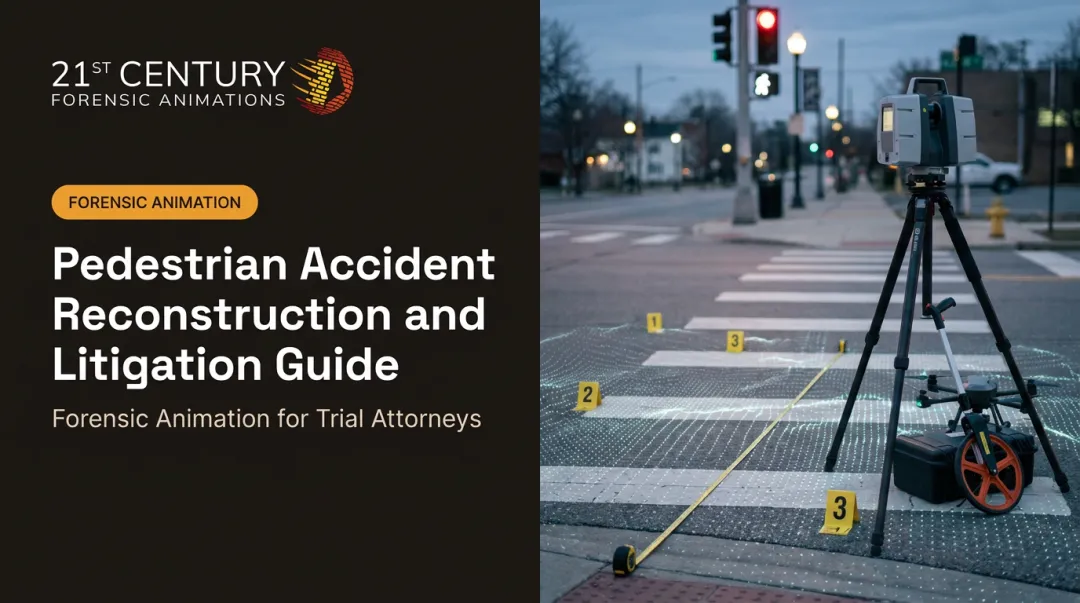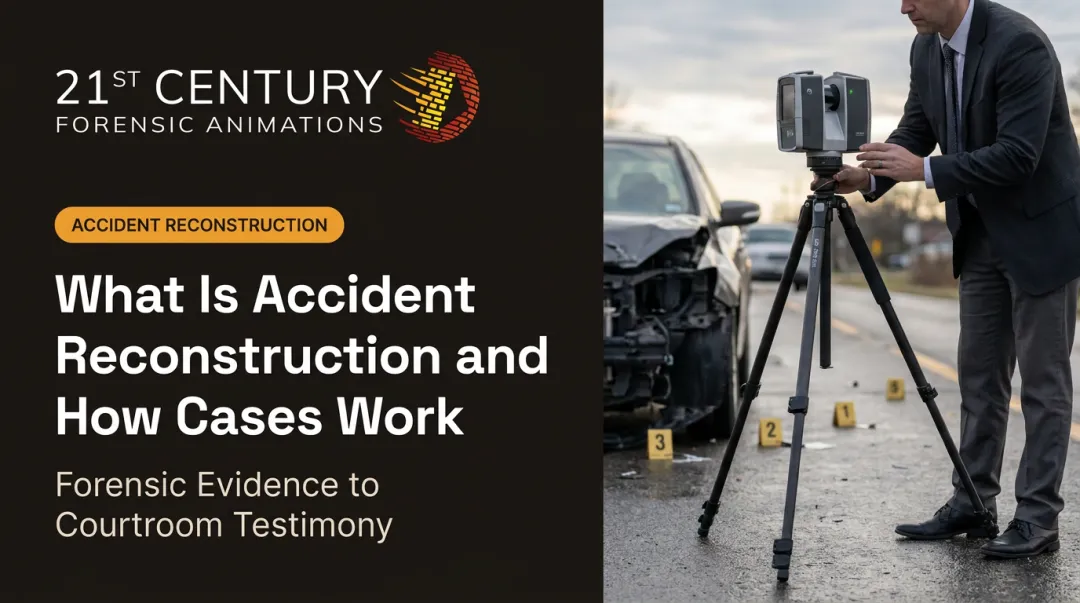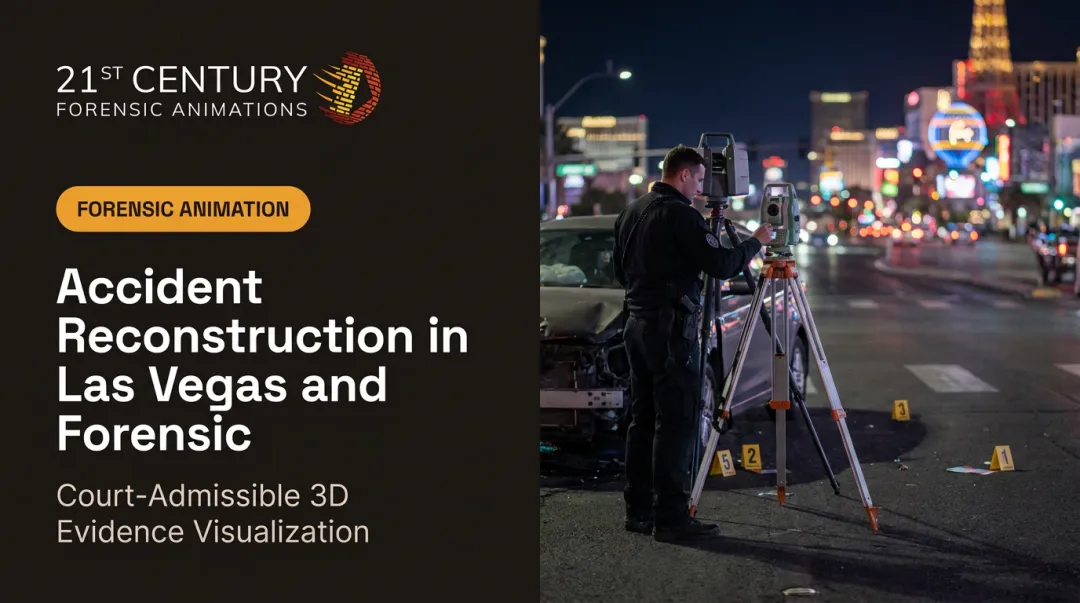

For trial attorneys, insurance adjusters, and courts, this matters because pedestrian cases are messy. Witnesses disagree. Injuries are severe. Liability disputes turn on split-second timing that no one measured in the moment. In 2023 alone, 7,314 pedestrians died and an estimated 68,244 were injured in traffic collisions in the United States, accounting for 18% of all traffic fatalities that year.
"Accident reconstruction" gets thrown around a lot, but few people outside the field understand what actually happens behind the scenes. This article breaks down the process step by step, the evidence involved, and when it's worth bringing in a specialist.
Key Takeaways
- Combines physics, engineering, and forensic evidence to establish speed and fault
- Follows a set sequence: documentation, evidence collection, analysis, then reconstruction
- Key evidence includes skid marks, crush profiles, injury patterns, and telematics footage
- Findings are presented in court through 3D animations that simplify complex physics for jurors
What Is Pedestrian Accident Reconstruction?
Pedestrian accident reconstruction is a specialized branch of accident reconstruction focused entirely on vehicle-to-pedestrian collisions. It's a different discipline than standard vehicle-to-vehicle reconstruction, which relies heavily on crush damage between two rigid structures.
A pedestrian's body doesn't behave like a second vehicle. It tumbles, wraps around a bumper, or gets thrown forward depending on speed and vehicle geometry. That added complexity requires its own set of tools and formulas.
The process is designed to establish four specific facts:
- Pre-impact vehicle speed at the moment of contact
- Point of impact on the roadway and on the vehicle itself
- Pedestrian position and movement immediately before the crash
- Driver and pedestrian visibility given lighting, sightlines, and obstructions

How It Differs From a Police Report
A police accident report documents what officers observed and recorded at the scene: statements, basic diagrams, and initial impressions of fault. It's a factual snapshot rather than an in-depth analysis.
Reconstruction goes further. It applies engineering-based calculations to that same scene and produces court-ready visual evidence that a police report was never designed to generate. The police report supplies the raw material; reconstruction turns that material into a finished, court-ready analysis.
Why Pedestrian Accident Reconstruction Matters in Injury Cases
Vehicle-to-vehicle collisions often leave behind crush damage on both cars and, increasingly, event data recorder logs that record speed and braking. Pedestrian cases don't always offer that same paper trail. A pedestrian doesn't leave skid marks, and there's no vehicle "black box" recording their movement.
The evidence is simply different, and it has to be pieced together with more precision.
What Goes Wrong Without Reconstruction
Without an engineering-based analysis, pedestrian cases tend to fall back on:
- Conflicting eyewitness accounts that vary widely on speed, timing, and who had the right of way
- Driver self-reporting, which naturally skews toward the driver's own version of events
- Incomplete police reports that document the scene but stop short of calculating what actually happened
Any one of these can misattribute fault, sometimes badly. A witness who says a car was "flying" might mean 45 mph or might mean 30. Reconstruction replaces that guesswork with math.
Courts Expect More Than Opinion
Expert testimony standards have tightened. Under Federal Rule of Evidence 702, the party offering expert testimony must show the opinion rests on sufficient facts, reliable methods, and a reliable application of those methods to the specific case. Courts aren't looking for a confident opinion anymore. They want documented methodology that can survive cross-examination.
That's pushed pedestrian reconstruction away from "expert says so" testimony and toward validated, evidence-based reports with clear reasoning a judge can evaluate. Firms with decades of court-tested methodology, like 21st Century Forensic Animations, are built to meet that bar.
How Pedestrian Accident Reconstruction Is Conducted: The Process Step by Step
Reconstruction moves in one direction: from raw scene evidence, through mathematical analysis, to a final visual representation that can be used in a claim or courtroom.
The inputs typically include:
- Police reports and initial scene diagrams
- Scene photographs and, where available, laser scan or drone-captured imagery
- Vehicle inspection data (damage, mechanical condition)
- Medical and autopsy records
- Video footage from surveillance cameras, dashcams, or nearby businesses
Specialists apply pedestrian-specific formulas that don't exist in standard car-to-car reconstruction, including throw distance models that estimate vehicle speed based on how far the pedestrian's body traveled after impact. These calculations account for launch angle, ground drag, and body mass, variables that simply don't apply when two vehicles collide.
One widely referenced model, a 2001 SAE paper on vehicle-pedestrian throw distance, relates vehicle contact speed directly to total pedestrian throw distance using mass ratios and drag coefficients.
Findings are usually cross-checked using more than one method, such as pairing throw-distance calculations with photogrammetric measurements pulled from scene photos, so the conclusion isn't resting on a single analytical approach.
Step 1: Scene Investigation and Evidence Preservation
Investigators visit the crash site as soon as possible to document road conditions, lighting, sightlines, signage, and any physical marks like scuffs, debris, or gouges. This evidence degrades fast. Rain washes away marks. Debris gets swept up. Road construction changes the layout entirely. Getting there early isn't optional.
Step 2: Vehicle and Physical Evidence Inspection
The striking vehicle gets a detailed inspection: crush profile, undercarriage damage, and whether headlights and brakes were functioning at the time. Where the vehicle made contact, and how deep that contact went, helps establish both impact speed and the exact point of contact with the pedestrian's body.
Step 3: Data and Injury Analysis
Injury location tells its own story. Lower limb injuries typically point to a bumper strike. Torso or head trauma usually means the pedestrian made contact with the hood or windshield. Matching injury patterns to vehicle contact points helps confirm, or challenge, other evidence in the case.
Step 4: Mathematical and Computational Analysis
This is where reconstructionists apply the physics: momentum, energy transfer, and pedestrian throw distance formulas. Where warranted, computer simulation software supports the calculations, generating pre-impact speed and trajectory estimates that get tested against the physical evidence already collected.
Step 5: 3D Visualization and Reporting
Findings get compiled into a formal report. Increasingly, that report is paired with a dimensionally accurate 3D animation or simulation that turns the physics into a visual sequence a jury can actually follow. Firms like 21st Century Forensic Animations specialize in producing these court-ready, physics-grounded visualizations, translating validated engineering conclusions into exhibits that hold up under cross-examination.

Timelines vary. A straightforward case with clear evidence might move through this process in a few weeks. Complex cases requiring multiple validation methods and detailed animation work take longer, depending on evidence availability and how tight the court's deadlines are.
Evidence, Data & Key Factors That Shape the Reconstruction
Reconstruction pulls from a wide evidence pool:
- Police and traffic collision reports
- Scene photographs and measurements
- Skid or scuff marks on the roadway
- Vehicle crush damage and mechanical condition
- Surveillance or dashcam footage
- Witness and deposition statements
- Medical and autopsy records
Injury Patterns as Evidence
Where the pedestrian was hit tells reconstructionists a lot. Lower extremity injuries generally indicate a bumper strike, the first point of contact in most collisions.
Head and thorax injuries usually suggest the pedestrian's body continued upward into the hood or windshield after initial contact. This sequence, known as primary and secondary impact, helps establish vehicle speed and point of impact with more precision than witness testimony alone can offer.
Factors That Affect the Outcome
- Documentation quality – photos, measurements, and video captured close to the time of the crash carry the most weight
- Environmental conditions – lighting, weather, and road surface at the moment of impact
- Vehicle-specific factors – type, speed, and mechanical condition of brakes, tires, and headlights
- Pedestrian variables – walking or running speed, body position, and visibility or conspicuity
- Jurisdictional rules of evidence – what methodology and testimony a given court will actually accept
Common Misconceptions and Choosing the Right Reconstruction Expert
It's Not Just a Computer Simulation
A common misconception treats reconstruction as if it's purely software-generated. It isn't. It's a rigorous, evidence-based process that starts with physical inspection and validated methodology. The computer work comes after the physical evidence has already been gathered and tested, not instead of it.
Report vs. Animation: Not the Same Thing
The reconstruction report contains the underlying analysis: the calculations, assumptions, and conclusions. The animation is a visual representation of those already-validated findings. It's not a substitute for the analysis behind it. A polished animation built on a weak reconstruction is still a weak reconstruction.
Not Every Case Needs Full Reconstruction
Minor incidents with clear, undisputed liability often don't justify the time or cost of a full reconstruction. This process delivers the most value when facts are genuinely disputed or when damages are catastrophic enough that getting the analysis right matters for the outcome.
What to Look For in a Qualified Expert
- Applies an engineering or physics background to real casework
- Demonstrates courtroom testimony experience defending methodology under cross-examination
- Produces dimensionally accurate, jurisdiction-compliant visual exhibits
Established firms with decades of forensic animation experience bring an added layer of credibility, since they've already documented their methodology across hundreds of prior cases.

21st Century Forensic Animations has worked since 1989 across civil, criminal, state, federal, and international rules of evidence. The firm offers a free consultation for attorneys weighing whether a pedestrian case needs full reconstruction or a lighter-touch analysis. Call (800) 460-2887 to start that conversation before the rest of the case takes shape.
Frequently Asked Questions
What are the steps in pedestrian accident reconstruction?
The process moves through scene investigation, vehicle and physical evidence inspection, injury and data analysis, mathematical calculation, and final visual reporting. Each step feeds into the next, building toward a validated conclusion.
How long does pedestrian accident reconstruction take?
Straightforward cases with clear evidence can take a few weeks. Complex cases requiring multiple analysis methods or detailed 3D animation work often take longer, depending on evidence availability and court deadlines.
What evidence is used in pedestrian accident reconstruction?
Main sources include police reports, scene photos, vehicle damage data, injury and medical records, video footage, and witness statements. Each piece gets cross-checked against the others.
What are the most common injuries in pedestrian accidents?
Injuries typically correlate with where the vehicle made contact. Lower extremity injuries often come from bumper strikes, while more severe head and thorax injuries usually result from hood or windshield contact.
Who conducts pedestrian accident reconstruction?
Engineers and trained specialists with backgrounds in physics, biomechanics, and accident investigation typically handle this work, often alongside forensic animation firms like 21st Century Forensic Animations that build the courtroom presentation.
Can pedestrian accident reconstruction be used as evidence in court?
Yes. When properly documented and methodologically sound, courts routinely accept reconstruction findings as expert evidence, often presented through visual exhibits or animations that help judges and juries understand complex physical evidence.