
That's the problem. Raw evidence lists, scene photos, and lab reports rarely communicate a clear sequence of events on their own. Judges, jurors, and claims adjusters are left guessing at what happened, in what order, and why it matters.
This article breaks down what crime scene reconstruction actually is, walks through its five stages and three recognized types, and explains why it carries so much weight in legal outcomes and courtroom presentation.
Key Takeaways
- Crime scene reconstruction pieces together how, when, and in what order an incident occurred using physical evidence.
- The process follows five stages: data collection, conjecture, hypothesis formulation, testing, and theory formation.
- Reconstructions generally fall into three categories: specific incident, event, and physical evidence reconstruction.
- Court-ready 3D visualizations translate technical findings into evidence judges and juries can understand.
What Is Crime Scene Reconstruction?
Crime scene reconstruction is the process of determining or eliminating events and actions at a scene by analyzing physical evidence, scene patterns, laboratory findings, and logically formulated theories. This applied science relies on deductive and inductive reasoning applied to verifiable data rather than assumption.
Reconstruction vs. Investigation
These two terms get used interchangeably, but they're distinct tasks. According to NIJ's guide for law enforcement, investigation covers assessing and controlling the scene, photographing and measuring it, documenting it through notes and sketches, and collecting evidence under chain of custody.
Reconstruction picks up where investigation ends. It's the interpretive layer that takes those documented findings and builds a coherent narrative out of them.
Reconstruction is genuinely multidisciplinary. A single case might involve:
- Forensic pathologists interpreting wound patterns
- Ballistics and bloodstain analysts
- Structural or mechanical engineers
- Forensic animators who translate findings into visual exhibits for litigation
Every reconstruction draws on a common set of inputs: physical evidence like blood, trajectories, and DNA; scene photographs and sketches; autopsy and lab reports; and witness statements. None of these tell the whole story alone. Reconstruction is what ties them together.
The 5 Stages of Crime Scene Reconstruction
Reconstruction isn't improvised case by case. Reconstruction doesn't happen through improvisation. It follows a structured, repeatable methodology that holds up across forensic disciplines, whether the case involves a homicide, a traffic collision, or a fire investigation.
Stage 1: Securing and Documenting the Scene
Before investigators touch anything, they have to preserve the scene. This means capturing photographs, video, sketches, and environmental notes before evidence shifts, degrades, or contamination sets in.
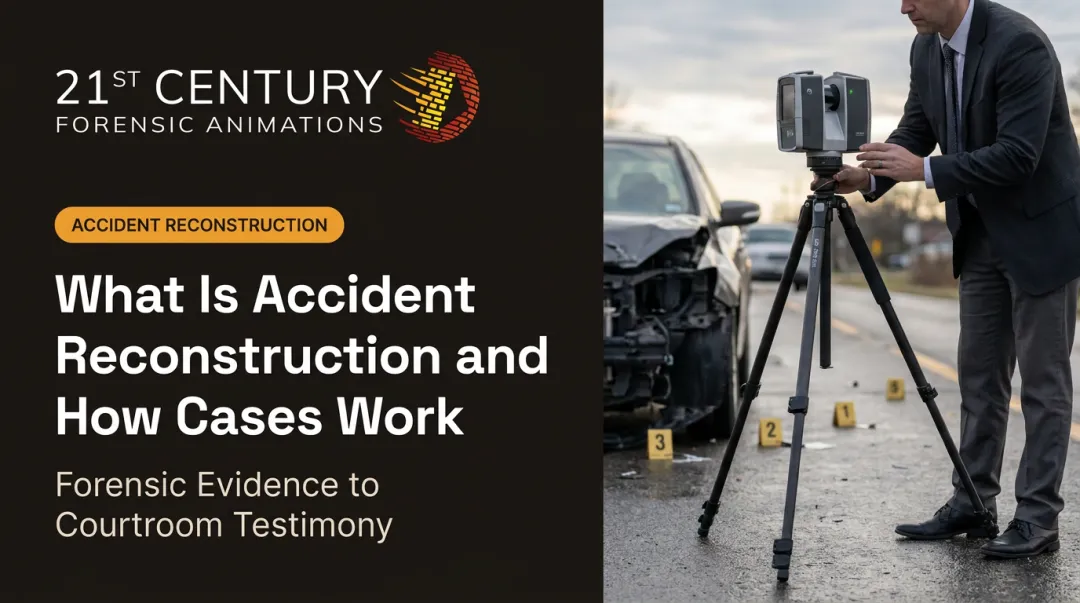
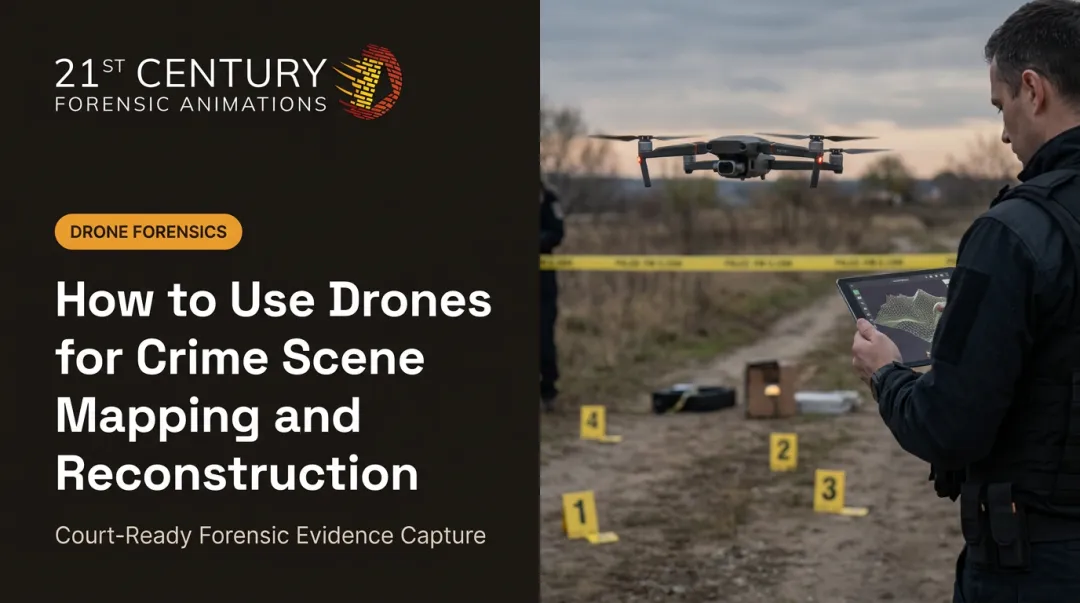
Modern documentation increasingly relies on laser scanning and drone imagery. 21st Century Forensic Animations, for example, uses this technology to capture millions of precise spatial measurements in a single pass, locking in the scene's exact geometry before conditions change.
Stage 2: Collecting and Preserving Evidence
Investigators systematically collect bloodstains, fingerprints, weapons, fibers, and other physical evidence, and chain-of-custody documentation matters here as much as the evidence itself. If evidence integrity breaks down, the reconstruction built on top of it becomes vulnerable to challenge.
Stage 3: Analyzing the Evidence
This is where raw evidence becomes usable data. Common techniques include:
- Bloodstain pattern analysis to determine positioning and movement
- Ballistics analysis to establish trajectories and firing positions
- DNA analysis to confirm identity and presence at the scene
- Trace evidence review covering fibers, glass, and gunshot residue
- Time-of-death estimation to narrow the window of events
Stage 4: Forming and Testing Hypotheses
Investigators draft preliminary theories about what likely happened, then stress-test each one against the physical evidence. Investigators discard any hypothesis that can't survive scrutiny, while only theories consistent with every piece of verified evidence move forward.
Stage 5: Reconstructing and Validating the Sequence
Investigators compile findings into a timeline or visual model, often through 3D modeling or animation. They then check that model against witness statements and any remaining evidence. If the visual and the testimony conflict, something in the reconstruction needs revisiting.

The 3 Types of Crime Scene Reconstruction
Forensic science generally groups reconstruction work into three overlapping categories, each with a slightly different focus.
Specific Incident Reconstruction
This addresses distinct categories of events: road traffic accidents, bombings, arson, homicides, and similar defined incident types. The reconstruction is shaped by the nature of the incident itself. An aviation crash investigation, for example, follows different protocols than a residential fire, even though both fall under this same category.
Event Reconstruction
Event reconstruction zeroes in on the connections between pieces of evidence: the sequence of actions, the relationships between people and objects, and who was involved at each point. In an officer-involved shooting, this often means mapping the exact positions, movements, and decisions made in the seconds before and after the incident.
Physical Evidence Reconstruction
This type centers on specific evidence categories, such as firearms, blood traces, or glass fragments, to work backward and determine what physically occurred. Ballistics analysis, for instance, can establish bullet trajectory and shooter position from spent casings and impact marks alone.
In practice, most real cases draw on all three at once. A shooting reconstruction might use physical evidence analysis (ballistics) to inform event reconstruction (who did what, in what order) within the broader context of a specific incident category (homicide).
Why Crime Scene Reconstruction Matters in Legal Cases
A pile of photographs and lab reports doesn't tell a jury much on its own. Reconstruction replaces that fragmented evidence with a coherent narrative: what happened, in what order, and how the physical evidence supports it.
Meeting Legal and Scientific Standards
Not every reconstruction makes it into evidence. Courts expect scientific reliability, evidence integrity, and transparency from expert reconstructions. The ANSI/ASB Standard for Scene Investigation and Reconstruction explicitly covers these principles, along with preservation of context and bias management, as foundational requirements for admissible reconstruction work.
The Jury Comprehension Problem
Meeting those standards is only half the battle. Bullet trajectories, bloodstain angles, and impact points are still difficult for laypeople to visualize from photos and written reports alone. A peer-reviewed study on computer-animated displays and juries found that mock jurors who viewed neutral animations aligned their judgments more closely with the physical evidence. When animations were built to favor one side, judgments drifted away from that evidence instead. The takeaway: visual evidence shapes verdicts, for better or worse, depending on how accurately it's built.

Forensic Animation as the Bridge
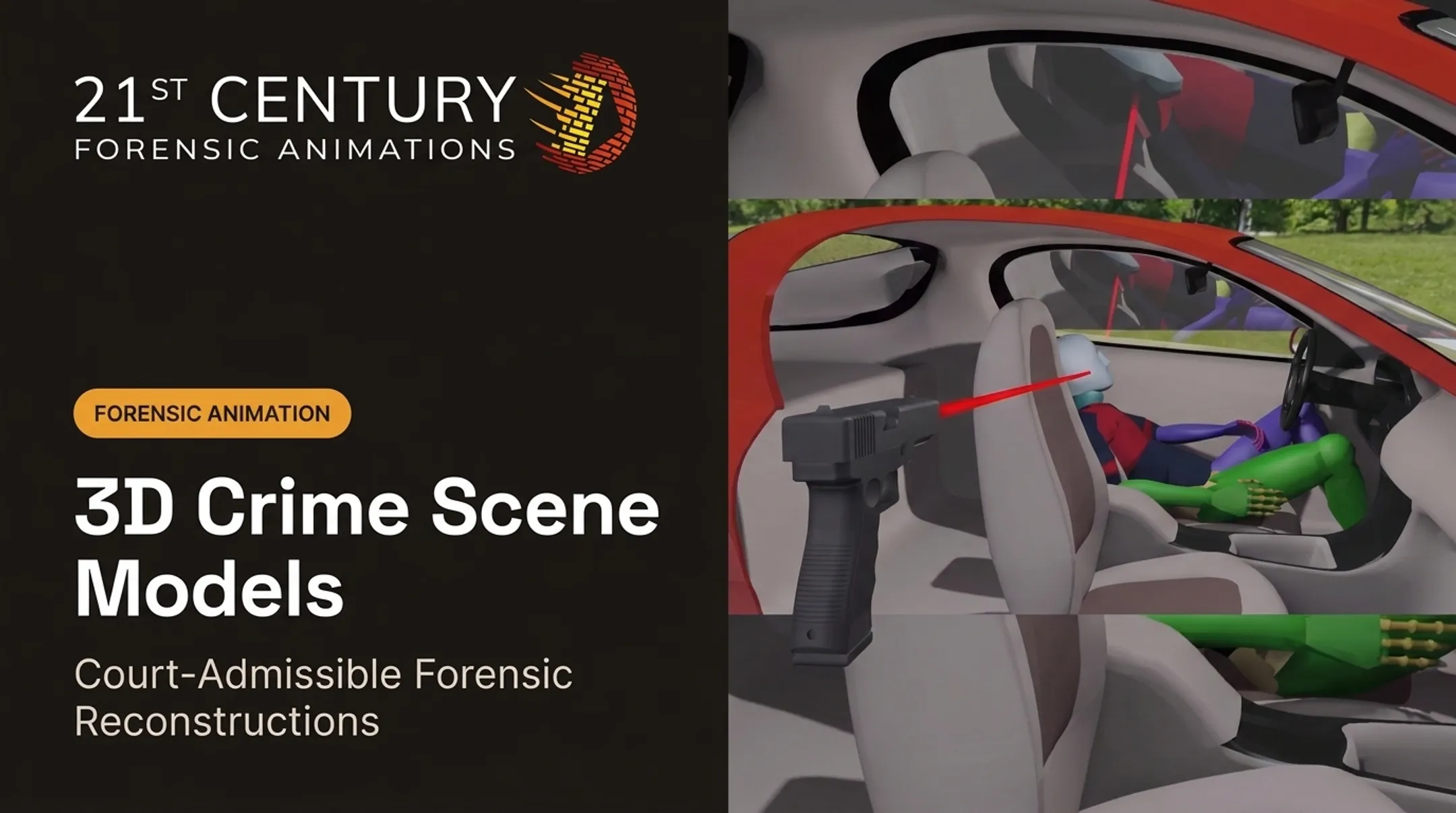
This is where forensic animation earns its place in the process. Firms like 21st Century Forensic Animations build dimensionally accurate, physics-grounded 3D visualizations that meet rules of evidence across civil, criminal, state, federal, and international jurisdictions.
Every exhibit is built from objective, verifiable sources, such as laser scans, photogrammetry, or physical evidence, with complete methodology documentation behind it. Their team also provides expert witness testimony to explain and defend that methodology in court when admissibility is challenged.
A credible, well-documented reconstruction does more than clarify a timeline. It can validate or refute witness statements outright, strengthen case objectivity, and frequently support stronger settlement negotiations or verdicts.
Real-World Applications and Examples
Consider a multi-vehicle collision. Investigators work through five distinct stages to reconstruct exactly what happened:
- Secure the scene and document skid marks and vehicle positions
- Collect physical fragments and pull data logs from onboard systems
- Analyze impact angles and speed using physics-based modeling
- Test competing theories about which vehicle initiated the collision
- Build a 3D animation validated against driver and witness statements
The result answers exactly what happened, in what order, and how.
This same process extends well beyond car crashes. Reconstruction and forensic animation show up across a wide range of case types:
- Motor vehicle accidents
- Aviation incidents
- Product liability
- Fires and explosions
- Ballistics and kinematics
- Officer-involved shootings
- War crimes
21st Century Forensic Animations has applied this methodology for 37 years as the oldest independent forensic animation firm in the industry, working across civil and criminal cases both domestically and internationally.
Their portfolio includes:
- A five-vehicle road rage collision reconstruction
- A capital murder case involving bullet trajectory and wound position analysis
- An electrocution liability case where laser scan data established exact power line placement relative to a residential property

Each case relied on the same core discipline: objective data, tested hypotheses, and a visual result that holds up under cross-examination.
Frequently Asked Questions
What is crime scene reconstruction?
It's the evidence-based process of analyzing physical evidence, witness statements, and forensic data to recreate the sequence of events during a crime or incident. It relies on scientific methods rather than assumption.
What are the 5 stages of crime scene reconstruction?
The five stages are securing and documenting the scene, collecting and preserving evidence, analyzing the evidence, forming and testing hypotheses, and reconstructing and validating the final sequence.
What are the three types of crime scene reconstruction?
Forensic science generally recognizes specific incident reconstruction, event reconstruction, and physical evidence reconstruction. Most real cases draw on elements of all three.
What is an example of crime scene reconstruction?
A common example uses bloodstain pattern analysis and ballistics to determine positions and movements during a shooting, establishing where each person stood and in what order actions occurred.
Who performs crime scene reconstruction?
Reconstructionists are forensic science practitioners, often former crime scene or homicide investigators, who analyze physical evidence and test hypotheses. In litigation, they frequently collaborate with forensic animators for courtroom presentation.
How does forensic animation support crime scene reconstruction in court?
Firms like 21st Century Forensic Animations translate complex reconstruction findings, such as trajectories or bloodstain angles, into accurate, court-ready 3D visualizations. This helps judges and juries understand evidence that's difficult to grasp from photos and reports alone.